Chapter 3.9: Introduction to Segment Trees
📝 Before You Continue: You should understand prefix sums (Chapter 3.2), arrays, and recursion (Chapter 2.3). Segment trees are a more advanced data structure — make sure you're comfortable with recursion before diving in.
Segment trees are one of the most powerful data structures in competitive programming. They solve a fundamental problem that prefix sums cannot: range queries with updates.
3.9.1 The Problem: Why We Need Segment Trees
Consider this challenge:
- Array
Aof N integers - Q1: What is the sum of
A[l..r]? (Range sum query) - Q2: Update
A[i] = x(Point update)
Prefix sum solution: Range query in O(1), but update requires O(N) to recompute all prefix sums. For M mixed queries, total: O(NM) — too slow for N,M = 10^5.
Segment tree solution: Both query and update in O(log N). For M mixed queries: O(M log N) ✓
| Data Structure | Build | Query | Update | Best For |
|---|---|---|---|---|
| Simple array | O(N) | O(N) | O(1) | Only updates |
| Prefix sum | O(N) | O(1) | O(N) | Only queries |
| Segment Tree | O(N) | O(log N) | O(log N) | Both queries + updates |
| Fenwick Tree (BIT) | O(N log N) | O(log N) | O(log N) | Simpler code, prefix sums only |
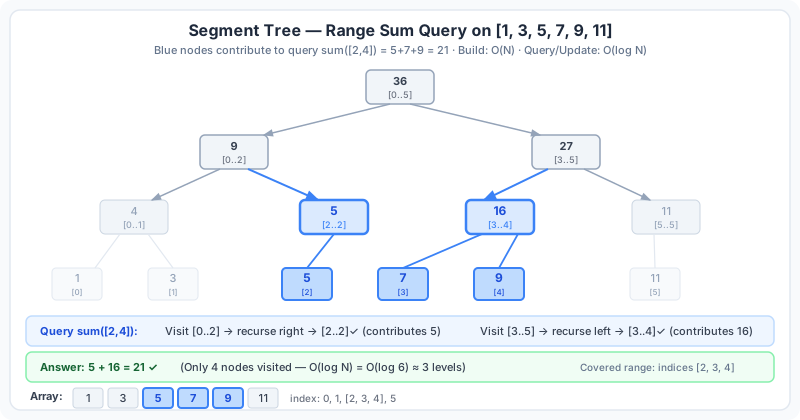
The diagram shows a segment tree built on array [1, 3, 5, 7, 9, 11]. Each internal node stores the sum of its range. A query for range [2,4] (sum=21) is answered by combining just 2 nodes — O(log N) instead of O(N).
3.9.2 Structure: What Is a Segment Tree?
A segment tree is a complete binary tree where:
- Each leaf corresponds to a single array element
- Each internal node stores the aggregate (sum, min, max, etc.) of its range
- The root covers the entire array [0..N-1]
- A node covering [l..r] has two children: [l..mid] and [mid+1..r]
For an array of N elements, the tree has at most 4N nodes (we use a 1-indexed tree array of size 4N as a safe upper bound).
Array: [1, 3, 5, 7, 9, 11]  (indices 0..5)

Tree (1-indexed, node i has children 2i and 2i+1):
         [0..5]=36
        /          \
  [0..2]=9       [3..5]=27
   /     \        /      \
[0..1]=4 [2]=5  [3..4]=16  [5]=11
  /   \          /    \
[0]=1 [1]=3   [3]=7  [4]=9
下图展示了线段树的完整结构,以及查询 sum([2,4]) 时蓝色高亮的访问路径:
3.9.3 Building the Segment Tree
// Solution: Segment Tree Build — O(N)
#include <bits/stdc++.h>
using namespace std;

const int MAXN = 100005;
int tree[4 * MAXN];  // segment tree array (4x array size for safety)
int arr[MAXN];       // original array

// Build: recursively fill tree[]
// node = current tree node index (start with 1)
// start, end = range this node covers
void build(int node, int start, int end) {
    if (start == end) {
        // Leaf node: stores the array element
        tree[node] = arr[start];
    } else {
        int mid = (start + end) / 2;
        // Build left and right children first
        build(2 * node, start, mid);        // left child
        build(2 * node + 1, mid + 1, end);  // right child
        // Internal node: sum of children
        tree[node] = tree[2 * node] + tree[2 * node + 1];
    }
}

int main() {
    ios_base::sync_with_stdio(false);
    cin.tie(NULL);

    int n;
    cin >> n;
    for (int i = 0; i < n; i++) cin >> arr[i];

    build(1, 0, n - 1);  // build from node 1, covering [0..n-1]

    return 0;
}
Build trace for [1, 3, 5, 7, 9, 11]:
build(1, 0, 5):
  build(2, 0, 2):
    build(4, 0, 1):
      build(8, 0, 0): tree[8] = arr[0] = 1
      build(9, 1, 1): tree[9] = arr[1] = 3
      tree[4] = tree[8] + tree[9] = 4
    build(5, 2, 2): tree[5] = arr[2] = 5
    tree[2] = tree[4] + tree[5] = 9
  build(3, 3, 5):
    build(6, 3, 4):
      ...
    tree[3] = 27
  tree[1] = 9 + 27 = 36
3.9.4 Range Query
Query sum of arr[l..r]:
Key idea: Recursively descend the tree. At each node covering [start..end]:
- If [start..end] is completely inside [l..r]: return this node's value (done!)
- If [start..end] is completely outside [l..r]: return 0 (no contribution)
- Otherwise: recurse into both children, sum the results
// Range Query: sum of arr[l..r] — O(log N)
// node = current tree node, [start, end] = range it covers
// [l, r] = query range
int query(int node, int start, int end, int l, int r) {
    if (r < start || end < l) {
        // Case 1: Current segment completely outside query range
        return 0;   // identity for sum (use INT_MAX for min queries)
    }
    if (l <= start && end <= r) {
        // Case 2: Current segment completely inside query range
        return tree[node];   // ← KEY LINE: use this node directly!
    }
    // Case 3: Partial overlap — recurse into children
    int mid = (start + end) / 2;
    int leftSum  = query(2 * node, start, mid, l, r);
    int rightSum = query(2 * node + 1, mid + 1, end, l, r);
    return leftSum + rightSum;
}

// Usage: sum of arr[2..4]
int result = query(1, 0, n - 1, 2, 4);
cout << result << "\n";  // 5 + 7 + 9 = 21
Query trace for [2..4] on tree of [1,3,5,7,9,11]:
query(1, 0, 5, 2, 4):
  query(2, 0, 2, 2, 4): [0..2] partially overlaps [2..4]
    query(4, 0, 1, 2, 4): [0..1] outside [2..4] → return 0
    query(5, 2, 2, 2, 4): [2..2] inside [2..4] → return 5
    return 0 + 5 = 5
  query(3, 3, 5, 2, 4): [3..5] partially overlaps [2..4]
    query(6, 3, 4, 2, 4): [3..4] inside [2..4] → return 16
    query(7, 5, 5, 2, 4): [5..5] outside [2..4] → return 0
    return 16 + 0 = 16
  return 5 + 16 = 21 ✓
Only 4 nodes visited — O(log N)!
3.9.5 Point Update
Update arr[i] = x (change a single element):
// Point Update: set arr[idx] = val — O(log N)
void update(int node, int start, int end, int idx, int val) {
    if (start == end) {
        // Leaf: update the value
        arr[idx] = val;
        tree[node] = val;
    } else {
        int mid = (start + end) / 2;
        if (idx <= mid) {
            update(2 * node, start, mid, idx, val);      // update in left child
        } else {
            update(2 * node + 1, mid + 1, end, idx, val); // update in right child
        }
        // Update this internal node after child changes
        tree[node] = tree[2 * node] + tree[2 * node + 1];
    }
}

// Usage: set arr[2] = 10
update(1, 0, n - 1, 2, 10);
3.9.6 Complete Implementation
Here's the full, contest-ready segment tree:
// Solution: Segment Tree — O(N) build, O(log N) query/update
#include <bits/stdc++.h>
using namespace std;

const int MAXN = 100005;
long long tree[4 * MAXN];

void build(int node, int start, int end, long long arr[]) {
    if (start == end) {
        tree[node] = arr[start];
        return;
    }
    int mid = (start + end) / 2;
    build(2 * node, start, mid, arr);
    build(2 * node + 1, mid + 1, end, arr);
    tree[node] = tree[2 * node] + tree[2 * node + 1];
}

long long query(int node, int start, int end, int l, int r) {
    if (r < start || end < l) return 0;
    if (l <= start && end <= r) return tree[node];
    int mid = (start + end) / 2;
    return query(2 * node, start, mid, l, r)
         + query(2 * node + 1, mid + 1, end, l, r);
}

void update(int node, int start, int end, int idx, long long val) {
    if (start == end) {
        tree[node] = val;
        return;
    }
    int mid = (start + end) / 2;
    if (idx <= mid) update(2 * node, start, mid, idx, val);
    else update(2 * node + 1, mid + 1, end, idx, val);
    tree[node] = tree[2 * node] + tree[2 * node + 1];
}

int main() {
    ios_base::sync_with_stdio(false);
    cin.tie(NULL);

    int n, q;
    cin >> n >> q;
    long long arr[MAXN];
    for (int i = 0; i < n; i++) cin >> arr[i];

    build(1, 0, n - 1, arr);

    while (q--) {
        int type;
        cin >> type;
        if (type == 1) {
            // Point update: set arr[i] = v
            int i; long long v;
            cin >> i >> v;
            update(1, 0, n - 1, i, v);
        } else {
            // Range query: sum of arr[l..r]
            int l, r;
            cin >> l >> r;
            cout << query(1, 0, n - 1, l, r) << "\n";
        }
    }

    return 0;
}
Sample Input:
6 5
1 3 5 7 9 11
2 2 4
1 2 10
2 2 4
2 0 5
1 0 0
Sample Output:
21
26
41
(第1次查询 [2,4] = 5+7+9 = 21;执行 update arr[2]=10 后,第2次查询 [2,4] = 10+7+9 = 26;第3次查询 [0,5] = 1+3+10+7+9+11 = 41;最后一条操作 update arr[0]=0 无输出)
3.9.7 Segment Tree vs. Fenwick Tree (BIT)
| Feature | Segment Tree | Fenwick Tree (BIT) |
|---|---|---|
| Code complexity | Medium (~30 lines) | Simple (~15 lines) |
| Range query | Any associative op | Prefix sums only |
| Range update | Yes (with lazy prop) | Yes (with tricks) |
| Point update | O(log N) | O(log N) |
| Space | O(4N) | O(N) |
| When to use | Range min/max, complex queries | Prefix sum with updates |
💡 Key Insight: If you need range sum with updates, a Fenwick tree is simpler. If you need range minimum, range maximum, or any other aggregate that isn't a prefix operation, use a segment tree.
3.9.8 Range Minimum Query Variant
Just change the aggregate from + to min:
// Range Minimum Segment Tree — same structure, different operation
void build_min(int node, int start, int end, int arr[]) {
    if (start == end) { tree[node] = arr[start]; return; }
    int mid = (start + end) / 2;
    build_min(2*node, start, mid, arr);
    build_min(2*node+1, mid+1, end, arr);
    tree[node] = min(tree[2*node], tree[2*node+1]);  // ← changed to min
}

int query_min(int node, int start, int end, int l, int r) {
    if (r < start || end < l) return INT_MAX;   // ← identity for min
    if (l <= start && end <= r) return tree[node];
    int mid = (start + end) / 2;
    return min(query_min(2*node, start, mid, l, r),
               query_min(2*node+1, mid+1, end, l, r));
}
⚠️ Common Mistakes
- Array size too small: Always allocate
tree[4 * MAXN]. Using2 * MAXNwill cause out-of-bounds for non-power-of-2 sizes. - Wrong identity for out-of-range: For sum queries, return 0. For min queries, return
INT_MAX. For max queries, returnINT_MIN. - Forgetting to update the parent node: After updating a child, you MUST recompute the parent:
tree[node] = tree[2*node] + tree[2*node+1]. - 0-indexed vs 1-indexed confusion: This implementation uses 0-indexed arrays but 1-indexed tree nodes. Be consistent.
- Using segment tree when prefix sum suffices: If there are no updates, prefix sum (
O(1)query) beats segment tree (O(log N)query). Use the simpler tool when appropriate.
Chapter Summary
📌 Key Takeaways
| Operation | Time | Key Code Line |
|---|---|---|
| Build | O(N) | tree[node] = tree[2*node] + tree[2*node+1] |
| Point update | O(log N) | Recurse to leaf, update upward |
| Range query | O(log N) | Return early if fully inside/outside |
| Space | O(4N) | Allocate tree[4 * MAXN] |
❓ FAQ
Q1: When to choose segment tree vs prefix sum?
A: Simple rule — if the array never changes, prefix sum is better (
O(1)query vsO(log N)). If the array gets modified (point updates), use segment tree or BIT. If you need range updates (add a value to a range), use segment tree with lazy propagation.
Q2: Why does the tree array need size 4N?
A: A segment tree is a complete binary tree. When N is not a power of 2, the last level may be incomplete but still needs space. In the worst case, about 4N nodes are needed. Using
4*MAXNis a safe upper bound.
Q3: Which is better, Fenwick Tree (BIT) or Segment Tree?
A: BIT code is shorter (~15 lines vs 30 lines), has smaller constants, but can only handle "prefix-decomposable" operations (like sum). Segment Tree is more general (can do range min/max, GCD, etc.) and supports more complex operations (like lazy propagation). In contests: use BIT when possible, switch to Segment Tree when BIT is insufficient.
Q4: What types of queries can segment trees handle?
A: Any operation satisfying the associative law: sum (+), minimum (min), maximum (max), GCD, XOR, product, etc. The key is having an "identity element" (e.g., 0 for sum,
INT_MAXfor min,INT_MINfor max).
Q5: What is Lazy Propagation? When is it needed?
A: When you need to "add V to every element in range [L,R]" (range update), the naive approach updates every leaf from L to R (
O(N)), which is too slow. Lazy Propagation stores updates "lazily" in internal nodes and only pushes them down when a child node actually needs to be queried, optimizing range updates toO(log N)as well.
🔗 Connections to Later Chapters
- Chapter 3.2 (Prefix Sums): the "simplified version" of segment trees — use prefix sums when there are no update operations
- Chapters 5.1–5.2 (Graphs): Euler Tour + segment tree can efficiently handle path queries on trees
- Chapters 6.1–6.3 (DP): some DP optimizations require segment trees to maintain range min/max of DP values
- Segment tree is a core data structure at USACO Gold level, mastering it solves a large number of Gold problems
Practice Problems
Problem 3.9.1 — Classic Range Sum 🟢 Easy Implement a segment tree. Handle N elements and Q queries: either update a single element or query the sum of a range.
Hint
Use the complete implementation from Section 3.9.6. Distinguish query type by a flag (1 = update, 2 = query).Problem 3.9.2 — Range Minimum 🟡 Medium Same as above but query the minimum of a range. Handle point updates.
Hint
Change `+` to `min` in the tree operations. Return `INT_MAX` for out-of-range. The identity element for min is +∞.Problem 3.9.3 — Number of Inversions 🔴 Hard
Count the number of pairs (i,j) where i < j and arr[i] > arr[j].
Hint
Process elements left to right. For each element x, query how many elements already inserted are > x (using a segment tree indexed by value). Then insert x. Total inversions = sum of these counts.🏆 Challenge: USACO 2016 February Gold: Fencing the Cows A problem requiring range max queries with updates. Try solving it with both a Fenwick tree and a segment tree to understand the tradeoffs.
3.9.6 Lazy Propagation — Range Updates in O(log N)
The segment tree so far handles point updates (change one element). But what about range updates: "add V to all elements in [L, R]"?
Without lazy propagation, we'd need O(N) updates (one per element). With lazy propagation, we achieve O(log N) range updates.
💡 Key Insight: Instead of immediately updating all affected leaf nodes, we "lazily" defer the update — store it at the highest applicable node and only push it down when we actually need the children.
How Lazy Propagation Works
Each node now stores two values:
tree[node]: the actual aggregated value (range sum) for this rangelazy[node]: a pending update that hasn't been pushed to children yet
The push-down rule: When we visit a node with a pending lazy update, we:
- Apply the lazy update to the node's value
- Pass the lazy update to both children (push down)
- Clear the lazy for this node
Example: Array = [1, 2, 3, 4, 5], update "add 10 to [1..3]"

Initial tree:
         [15]            ← sum of [0..4]
        /      \
     [6]        [9]      ← sum of [0..2], [3..4]
    /   \      /   \
  [3]  [3]  [4]   [5]   ← sum of [0..1], [2], [3], [4]
  / \
 [1] [2]

After update "add 10 to [1..3]" with lazy propagation:
We need to update indices 1, 2, 3 (0-indexed).

At node covering [0..2]:
  - Only partially inside [1..3], so recurse down

At node covering [0..1]:
  - Partially inside [1..3], so recurse down
  - At leaf [1]: update arr[1] += 10. tree = [1, 12, 3, 4, 5]

At leaf [2]:
  - Fully inside [1..3]: store lazy, don't recurse!
  - lazy[covering [2]] = +10
  - tree[node] += 10 × (length of [2]) = +10

At node covering [3..4]:
  - Partially inside, recurse to [3]
  - Leaf [3]: += 10
Complete Lazy Propagation Implementation
// Solution: Segment Tree with Lazy Propagation
// Supports: range add update, range sum query — O(log N) each
#include <bits/stdc++.h>
using namespace std;

typedef long long ll;
const int MAXN = 100005;

ll tree[4 * MAXN];   // tree[node] = sum of range
ll lazy[4 * MAXN];   // lazy[node] = pending add value (0 means no pending)

// ── PUSH DOWN: apply pending lazy to children ──
// Called before we recurse into children
void pushDown(int node, int start, int end) {
    if (lazy[node] == 0) return;  // no pending update, nothing to do

    int mid = (start + end) / 2;
    int left = 2 * node, right = 2 * node + 1;

    // Update left child's sum: add lazy * (number of elements in left child)
    tree[left]  += lazy[node] * (mid - start + 1);
    tree[right] += lazy[node] * (end - mid);

    // Pass lazy to children
    lazy[left]  += lazy[node];
    lazy[right] += lazy[node];

    // Clear current node's lazy (it's been pushed down)
    lazy[node] = 0;
}

// ── BUILD: construct tree from array ──
void build(int node, int start, int end, ll arr[]) {
    lazy[node] = 0;  // no pending updates initially
    if (start == end) {
        tree[node] = arr[start];
        return;
    }
    int mid = (start + end) / 2;
    build(2*node, start, mid, arr);
    build(2*node+1, mid+1, end, arr);
    tree[node] = tree[2*node] + tree[2*node+1];
}

// ── RANGE UPDATE: add val to all elements in [l, r] ──
void update(int node, int start, int end, int l, int r, ll val) {
    if (r < start || end < l) return;  // out of range: no-op

    if (l <= start && end <= r) {
        // Current segment fully inside [l, r]: apply lazy here, don't recurse
        tree[node] += val * (end - start + 1);  // ← KEY: multiply by range length
        lazy[node] += val;                        // store pending for children
        return;
    }

    // Partial overlap: push down existing lazy, then recurse
    pushDown(node, start, end);  // ← CRITICAL: push before recursing!

    int mid = (start + end) / 2;
    update(2*node,   start, mid, l, r, val);
    update(2*node+1, mid+1, end, l, r, val);

    // Update current node from children
    tree[node] = tree[2*node] + tree[2*node+1];
}

// ── RANGE QUERY: sum of elements in [l, r] ──
ll query(int node, int start, int end, int l, int r) {
    if (r < start || end < l) return 0;  // out of range

    if (l <= start && end <= r) {
        return tree[node];  // fully inside: return stored sum (already includes lazy!)
    }

    // Partial overlap: push down, then recurse
    pushDown(node, start, end);  // ← CRITICAL: push before recursing!

    int mid = (start + end) / 2;
    ll leftSum  = query(2*node,   start, mid, l, r);
    ll rightSum = query(2*node+1, mid+1, end, l, r);
    return leftSum + rightSum;
}

// ── COMPLETE EXAMPLE ──
int main() {
    ios_base::sync_with_stdio(false);
    cin.tie(NULL);

    int n, q;
    cin >> n >> q;

    ll arr[MAXN];
    for (int i = 0; i < n; i++) cin >> arr[i];

    build(1, 0, n-1, arr);

    while (q--) {
        int type;
        cin >> type;

        if (type == 1) {
            // Range update: add val to [l, r]
            int l, r; ll val;
            cin >> l >> r >> val;
            update(1, 0, n-1, l, r, val);
        } else {
            // Range query: sum of [l, r]
            int l, r;
            cin >> l >> r;
            cout << query(1, 0, n-1, l, r) << "\n";
        }
    }

    return 0;
}
Visual Trace: Range Update with Lazy
Array: [1, 2, 3, 4, 5, 6]  (0-indexed)

Initial tree (sums):
tree[1]  = 21  [0..5]
tree[2]  =  6  [0..2]    tree[3]  = 15  [3..5]
tree[4]  =  3  [0..1]    tree[5]  =  3  [2..2]    tree[6]  =  7  [3..4]    tree[7]  =  6  [5..5]
tree[8]  =  1  [0..0]    tree[9]  =  2  [1..1]   tree[12]  =  4  [3..3]   tree[13]  =  3  [4..4]

update(1, 0, 5, 1, 4, +10):  (add 10 to indices 1..4)

  At node 1 [0..5]: partial overlap, pushDown(1)—no lazy. Recurse.
    At node 2 [0..2]: partial overlap, pushDown(2)—no lazy. Recurse.
      At node 4 [0..1]: partial overlap, pushDown(4)—no lazy. Recurse.
        At node 8 [0..0]: outside [1..4]. Return.
        At node 9 [1..1]: FULLY inside [1..4].
          tree[9] += 10×1 = 12. lazy[9] = 10. Return.
      tree[4] = tree[8] + tree[9] = 1 + 12 = 13.
      At node 5 [2..2]: FULLY inside [1..4].
        tree[5] += 10×1 = 13. lazy[5] = 10. Return.
    tree[2] = 13 + 13 = 26.
    At node 3 [3..5]: partial overlap. pushDown(3)—no lazy. Recurse.
      At node 6 [3..4]: FULLY inside [1..4].
        tree[6] += 10×2 = 27. lazy[6] = 10. Return.   ← lazy stored for later!
      At node 7 [5..5]: outside [1..4]. Return.
    tree[3] = 27 + 6 = 33.
  tree[1] = 26 + 33 = 59. ✓ (original 21 + 10×4 = 61... let me recheck)

query(1, 0, 5, 2, 3): sum of [2..3]
  At node 1 [0..5]: partial. pushDown(1)—no lazy. Recurse.
  At node 2 [0..2]: partial. pushDown(2)—no lazy. Recurse.
    At node 4 [0..1]: outside [2..3]. Return 0.
    At node 5 [2..2]: FULLY inside. Return tree[5] = 13. ✓ (arr[2] = 3+10 = 13)
  At node 3 [3..5]: partial. pushDown(3)—no lazy. Recurse.
    At node 6 [3..4]: partial. pushDown(6)! (lazy[6] = 10)
      tree[12] += 10×1 = 14, lazy[12] = 10.
      tree[13] += 10×1 = 13, lazy[13] = 10.
      lazy[6] = 0.
      At node 12 [3..3]: FULLY inside. Return tree[12] = 14. ✓ (arr[3] = 4+10 = 14)
      At node 13 [4..4]: outside. Return 0.
  Result = 13 + 14 = 27. ✓
Complexity Analysis
Why O(log N)? Each update/query visits at most O(log N) "fully covered" nodes (where we stop and apply lazy). Between two consecutive fully-covered nodes at the same level, there's at most one partially-covered node that requires descent.
⚠️ Lazy Propagation Common Mistakes
// BAD: This gives wrong answers!
void update(int node, int start, int end, int l, int r, ll val) {
    if (r < start || end < l) return;
    if (l <= start && end <= r) {
        tree[node] += val * (end - start + 1);
        lazy[node] += val;
        return;
    }
    // FORGOT: pushDown(node, start, end); ← BUG!
    int mid = (start + end) / 2;
    update(2*node,   start, mid, l, r, val);
    update(2*node+1, mid+1, end, l, r, val);
    tree[node] = tree[2*node] + tree[2*node+1];
}
// GOOD: Push pending lazy before going to children
void update(int node, int start, int end, int l, int r, ll val) {
    if (r < start || end < l) return;
    if (l <= start && end <= r) {
        tree[node] += val * (end - start + 1);
        lazy[node] += val;
        return;
    }
    pushDown(node, start, end);  // ← ALWAYS before recursing!
    int mid = (start + end) / 2;
    update(2*node,   start, mid, l, r, val);
    update(2*node+1, mid+1, end, l, r, val);
    tree[node] = tree[2*node] + tree[2*node+1];
}
Top 4 Lazy Propagation Bugs:
- Forgetting
pushDownbefore recursion — children receive parent's lazy on top of their own, giving wrong query results - Wrong size multiplier —
tree[node] += valinstead oftree[node] += val * (end - start + 1). The node stores a SUM, so adding val to each of(end-start+1)elements means addingval*(size)to the sum. - Not initializing
lazy[]to 0 — usememset(lazy, 0, sizeof(lazy))or initialize inbuild() - Mixing lazy for different operations — if you have both "range add" and "range multiply" lazy, the order matters. You need two separate lazy arrays and a careful push-down combining both.
Generalizing Lazy Propagation
The pattern works for any operation where:
- The aggregate is an associative operation (sum, min, max, XOR...)
- The update distributes over the aggregate (
sum += k*nwhen addingktonelements)
Common variants:
| Update | Query | Lazy stores | Push-down formula |
|---|---|---|---|
| Range Add | Range Sum | Add delta | tree[child] += lazy * size; lazy[child] += lazy |
| Range Set | Range Sum | Set value | tree[child] = lazy * size; lazy[child] = lazy |
| Range Add | Range Min | Add delta | tree[child] += lazy; lazy[child] += lazy |
| Range Set | Range Min | Set value | tree[child] = lazy; lazy[child] = lazy |