Chapter 7.1: Understanding USACO
Before you can ace a competition, you need to understand how it works. This chapter covers everything about USACO's structure, rules, and scoring that you need to know to compete effectively.
7.1.1 What Is USACO?
The USA Computing Olympiad (USACO) is the premier competitive programming contest for pre-college students in the United States. Established in 1993, it selects the US team for the International Olympiad in Informatics (IOI).
Key facts:
- Completely free and open to anyone
- Competed from home, on your own computer
- Problems involve algorithms and data structures
- No math competition, no trivia — pure algorithmic thinking
7.1.2 Contest Format
Schedule
USACO holds 4 contests per year:
- December contest (typically first or second week)
- January contest
- February contest
- US Open (March/April) — a bit harder, 5 hours instead of 4
Contests open on a Friday and close after 4 hours of actual competition time (you choose when to start, within a 3-day window).
Problems
Each contest has 3 problems. The time limit is 4 hours (US Open: 5 hours).
Input/Output
- Problems use file I/O OR standard I/O (newer contests use standard I/O)
- For file I/O: input from
problem.in, output toproblem.out - Template for file I/O:
#include <bits/stdc++.h>
using namespace std;

int main() {
    // Redirect cin/cout to files
    freopen("problem.in", "r", stdin);
    freopen("problem.out", "w", stdout);

    ios_base::sync_with_stdio(false);
    cin.tie(NULL);

    // Your solution here

    return 0;
}
Important: Starting from 2020, most USACO problems use standard I/O. Always check the problem statement!
7.1.3 The Four Divisions
USACO has four competitive divisions, each with distinct difficulty:
Visual: USACO Divisions Pyramid
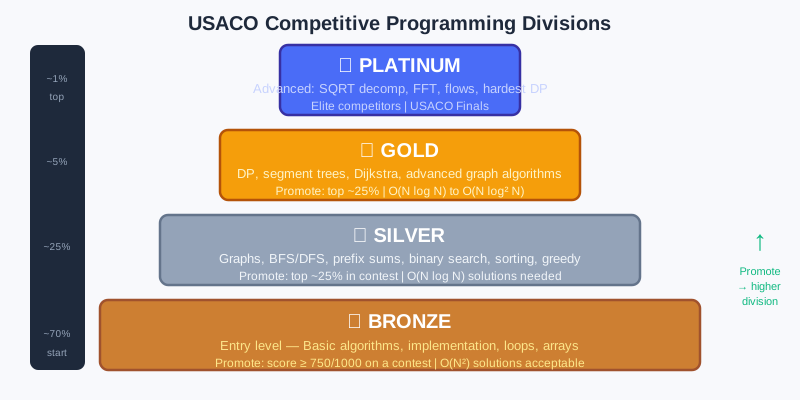
The pyramid shows USACO's four divisions from entry-level Bronze at the base to elite Platinum at the top. Each tier requires mastery of the concepts below it. The percentages indicate roughly what fraction of contestants compete at each level.
🥉 Bronze
- Audience: Beginners with basic programming knowledge
- Algorithms: Simulation, brute force, basic loops, simple arrays
- Typical complexity: O(N²) or O(N³) for small N, sometimes O(N) with insights
- N constraints: Usually ≤ 1000 or very small
- Promotion threshold: Score 750/1000 or higher (exact threshold varies)
🥈 Silver
- Audience: Intermediate programmers
- Algorithms: Sorting, binary search, BFS/DFS, prefix sums, basic DP, greedy
- Typical complexity: O(N log N) or O(N)
- N constraints: Up to 10^5
- Promotion threshold: Score 750+/1000
🥇 Gold
- Audience: Advanced programmers
- Algorithms: Dijkstra, segment trees, advanced DP, network flow, LCA
- Typical complexity: O(N log N) to O(N log² N)
- N constraints: Up to 10^5 to 10^6
💎 Platinum
- Audience: Top competitors
- Algorithms: Difficult combinatorics, advanced data structures, geometry
- Top performers qualify for the USACO Finalist camp and possibly the IOI team (4 selected per year)
7.1.4 Scoring
How Scoring Works
Each problem has multiple test cases (typically 10–15). You earn partial credit for each test case you pass.
- Each problem is worth approximately 333 points
- Total: ~1000 points per contest
- Exact breakdown depends on the contest
The All-Or-Nothing Myth
People think you need the perfect solution. You don't! Partial credit from simpler cases (smaller N, special structures) can get you to 750+ for promotion. In Bronze especially, many partial credit strategies exist.
Partial Credit Strategies
If you can't solve a problem fully:
- Solve small cases: If N ≤ 20, brute force with O(N!) or O(2^N) often passes several test cases
- Solve special cases: If the graph is a tree, or all values are equal, solve those first
- Output always the same answer: If you think the answer is always "YES" or some constant, try it for the first few test cases
- Time out gracefully: Make sure your partial solution doesn't crash — a TLE is better than a runtime error for some OJs
7.1.5 Time Management in Contests
The 4-Hour Strategy
First 30 minutes: Read all 3 problems. Don't code yet. Just understand them and think.
- Identify which problem looks easiest
- Note any edge cases or trick conditions
- Start forming approaches in your head
Hours 1-2: Solve the easiest problem (usually problem 1 or 2).
- Implement, test against examples, debug
- Aim for 100% on at least one problem
Hours 2-3: Tackle the second-easiest problem.
- If stuck, consider partial credit approaches
Final hour: Either finish the third problem or consolidate/debug existing solutions.
- With 30 minutes left: stop adding new code; focus on testing and fixing bugs
Reading the Problem
Spend 5–10 minutes reading each problem before writing any code:
- Re-read the constraints (N, values, special conditions)
- Work through the examples manually on paper
- Think: "What algorithm does this remind me of?"
If You're Stuck
- Try small examples manually — what pattern do you see?
- Think about simpler versions: what if N=1? N=2? N=10?
- Consider: is this a graph problem? A DP? A sorting/greedy problem?
- Write brute force first — it might be fast enough, or it helps you understand the structure
7.1.6 Common Mistake Patterns
1. Off-by-One Errors
// Wrong: misses last element
for (int i = 0; i < n - 1; i++) { ... }

// Wrong: accesses arr[n] — out of bounds!
for (int i = 0; i <= n; i++) { cout << arr[i]; }

// Correct
for (int i = 0; i < n; i++) { ... }      // 0-indexed
for (int i = 1; i <= n; i++) { ... }     // 1-indexed
2. Integer Overflow
int a = 1e9, b = 1e9;
int wrong = a * b;            // OVERFLOW
long long right = (long long)a * b;  // Correct
3. Uninitialized Variables
int ans;  // uninitialized — has garbage value!
// Always initialize:
int ans = 0;
int best = INT_MIN;
4. Wrong Answer on Empty Input / Edge Cases
// What if n = 0?
int maxVal = arr[0];  // crash if n = 0!
// Check: if (n == 0) { cout << 0; return 0; }
5. Using endl Instead of "\n"
// Slow (flushes buffer every time)
for (int i = 0; i < n; i++) cout << arr[i] << endl;

// Fast
for (int i = 0; i < n; i++) cout << arr[i] << "\n";
6. Forgetting to Handle All Cases
Read the problem carefully. "What if all cows have the same height?" "What if N=1?" Test these edge cases.
7.1.7 Bronze Problem Types Cheat Sheet
| Category | Description | Key Technique |
|---|---|---|
| Simulation | Follow instructions step by step | Implement carefully; use arrays/maps |
| Counting | Count elements satisfying some condition | Loops, prefix sums, hash maps |
| Geometry | Points, rectangles on a grid | Index carefully, avoid float errors |
| Sorting-based | Sort and check properties | std::sort + scan |
| String processing | Manipulate character sequences | String indexing, maps |
| Ad hoc | Clever observation, no standard algo | Read carefully, find the pattern (see Chapter 7.3) |
Chapter Summary
📌 Key Takeaways
| Topic | Key Points |
|---|---|
| Format | 4 contests per year, 4 hours each, 3 problems |
| Divisions | Bronze → Silver → Gold → Platinum |
| Scoring | ~1000 points per contest, need 750+ to advance |
| Partial credit | Brute force on small data still earns points |
| Time management | Read all problems first, start with the easiest |
| Common bugs | Overflow, off-by-one, uninitialized variables |
❓ FAQ
Q1: What language does USACO use? Is C++ recommended?
A: USACO supports C++, Java, Python. C++ is strongly recommended — it's the fastest (Python is 10-50x slower), with a rich STL. Java works too, but is ~2x slower than C++ and more verbose. This book uses C++ throughout.
Q2: How long does it take to advance from Bronze to Silver?
A: It varies. Students with programming background typically take 2-6 months (5-10 hours of practice per week). Complete beginners may need 6-12 months. The key is not the time, but effective practice — solve problems + read editorials + reflect.
Q3: Can you look things up online during the contest?
A: You can look up general reference materials (like C++ reference, algorithm tutorials), but cannot look up existing USACO editorials or get help from others. USACO is open-resource but independently completed.
Q4: Is there a penalty for wrong answers?
A: No. USACO allows unlimited resubmissions, and only the last submission counts. So submitting a partially correct solution first, then optimizing, is a smart strategy.
Q5: When should you give up on a problem and move to the next?
A: If you've been stuck on a problem for 40+ minutes with no new ideas, consider moving to the next. But before switching, submit your current code to get partial credit. Come back if you have time at the end.
🔗 Connections to Other Chapters
- Chapters 2.1-2.3 (Part 2) cover all C++ knowledge needed for Bronze
- Chapters 3.1-3.11 (Part 3) cover core data structures and algorithms for Silver
- Chapters 5.1-5.4 (Part 5) cover graph theory at the Silver/Gold boundary
- Chapters 4.1-4.2, 6.1-6.3 (Parts 4, 6) cover greedy and DP for Silver/Gold
- Chapter 7.2 continues this chapter with deeper problem-solving strategies and thinking methods
- Chapter 7.3 gives a full deep dive into ad hoc problems — the 10–15% of Bronze problems that require creative observation rather than standard algorithms
7.1.8 Complete Bronze Problem Taxonomy
Bronze problems fall into these 10 categories. Knowing the taxonomy helps you recognize patterns instantly.
| # | Category | Description | Key Approach | Example |
|---|---|---|---|---|
| 1 | Simulation | Follow given rules step by step | Implement carefully, use arrays | "Simulate N cows moving" |
| 2 | Counting / Iteration | Count elements satisfying a condition | Nested loops, prefix sums | "Count pairs with sum K" |
| 3 | Sorting + Scan | Sort, then scan with a simple check | std::sort + linear scan | "Find median, find closest pair" |
| 4 | Grid / 2D array | Process cells in a 2D grid | Index carefully, BFS/DFS | "Count connected regions" |
| 5 | String processing | Manipulate character sequences | String indexing, maps | "Find most frequent substring" |
| 6 | Brute Force Search | Try all possibilities | Nested loops over small N | "Try all subsets of ≤ 20 items" |
| 7 | Geometry (integer) | Points, rectangles on a grid | Integer arithmetic, no floats | "Area of overlapping rectangles" |
| 8 | Math / Modular | Number theory, patterns | Modular arithmetic, formulas | "Nth element of sequence" |
| 9 | Data Structure | Use the right container | Map, set, priority queue | "Who arrives first?" |
| 10 | Ad Hoc / Observation | Clever insight, no standard algo | Read carefully, find pattern | "Unique USACO-flavored problems" — see Chapter 7.3 for deep dive |
Bronze Category Breakdown (estimated frequency):
Simulation:         ████████████ ~30%
Counting/Loops:     ████████     ~20%
Sorting+Scan:       ██████       ~15%
Grid/2D:            █████        ~12%
Ad Hoc:             █████        ~12%
Other:              ████         ~11%
7.1.9 Silver Problem Taxonomy
Silver problems require more sophisticated algorithms. Here are the main categories:
| Category | Key Algorithms | N Constraint | Time Needed |
|---|---|---|---|
| Sorting + Greedy | Sort + sweep, interval scheduling | N ≤ 10^5 | O(N log N) |
| Binary Search | BS on answer, parametric search | N ≤ 10^5 | O(N log N) or O(N log² N) |
| BFS/DFS | Shortest path, components, flood fill | N ≤ 10^5 | O(N + M) |
| Prefix Sums | 1D/2D range queries, difference arrays | N ≤ 10^5 | O(N) |
| Basic DP | 1D DP, LIS, knapsack, grid paths | N ≤ 5000 | O(N²) or O(N log N) |
| DSU | Dynamic connectivity, Kruskal's MST | N ≤ 10^5 | O(N α(N)) |
| Graph + DP | DP on trees, DAG paths | N ≤ 10^5 | O(N) or O(N log N) |
Time Complexity Limits for USACO
This is crucial: USACO problems have tight time limits (typically 2–4 seconds). Use this table to determine the required algorithm complexity.
| N (input size) | Required Complexity | Allowed Algorithms |
|---|---|---|
| N ≤ 10 | O(N!) | Permutation brute force |
| N ≤ 20 | O(2^N × N) | Bitmask DP, full search |
| N ≤ 100 | O(N³) | Floyd-Warshall, interval DP |
| N ≤ 1,000 | O(N²) | Standard DP, pairwise |
| N ≤ 10,000 | O(N² / constants) | Optimized O(N²) sometimes OK |
| N ≤ 100,000 | O(N log N) | Sort, BFS, binary search, DSU |
| N ≤ 1,000,000 | O(N) | Linear algorithms, prefix sums |
| N ≤ 10^9 | O(log N) | Binary search, math formulas |
⚠️ Rule of thumb: ~10^8 simple operations per second. With N=10^5, O(N²) = 10^10 operations → TLE. You need O(N log N) or better.
7.1.10 How to Upsolve — When You're Stuck
"Upsolving" means solving a problem you couldn't solve during the contest, after looking at hints or the editorial. It's the most important skill for improving at USACO.
Step-by-Step Upsolving Process
Step 1: Struggle first (30–60 min)
- Don't look at the editorial immediately. Struggling builds intuition.
- Try small examples (N=2, N=3). What's the pattern?
- Think: "What algorithm does this smell like?"
Step 2: Get a hint, not the solution
- Look at just the first line of the editorial: "This is a BFS problem" or "Sort first."
- Try again with just that hint.
Step 3: Read the full editorial
- Read slowly. Understand why the algorithm works, not just what it does.
- Ask yourself: "What insight am I missing? Why didn't I think of this?"
Step 4: Implement from scratch
- Don't copy the editorial's code. Write it yourself.
- This is where real learning happens.
Step 5: Identify your gap
- Was the issue recognizing the algorithm type? → Study more problem patterns.
- Was the issue implementation? → Practice coding faster, learn STL better.
- Was the issue the observation/insight? → Practice thinking about properties and invariants.
Common Reasons People Get Stuck
| Reason | Fix |
|---|---|
| Don't recognize the algorithm | Study more patterns; classify every problem you solve |
| Know algorithm but can't implement | Code templates from memory daily |
| Algorithm is correct but wrong answer | Check edge cases: N=1, all same values, empty input |
| Algorithm is correct but TLE | Review complexity; look for unnecessary O(N) loops inside O(N) loops |
| Panicked during contest | Practice under timed conditions |
The "Algorithm Recognition" Mental Checklist
When reading a USACO problem, ask yourself:
1. What's N? (N≤20 → bitmask; N≤10^5 → O(N log N))
2. Is there a graph/grid? → BFS/DFS
3. Is there a "minimum/maximum subject to constraint"? → Binary search on answer
4. Can the problem be modeled as: "best subsequence"? → DP
5. "Minimize max" or "maximize min"? → Binary search or greedy
6. "Connect/disconnect" queries? → DSU
7. "Range queries"? → Prefix sums or segment tree
8. Seems combinatorial with small N? → Try all cases (bitmask or permutations)
7.1.11 USACO Patterns Cheat Sheet
| Pattern | Recognition Keywords | Algorithm | Example Problem |
|---|---|---|---|
| Shortest path grid | "minimum steps", "maze", "BFS" | BFS | Maze navigation |
| Nearest X to each cell | "closest fire", "distance to nearest" | Multi-source BFS | Fire spreading |
| Sort + scan | "close together", "largest gap" | Sort, adjacent pairs | Closest pair of cows |
| Binary search on answer | "maximize minimum distance", "minimize maximum" | BS + check | Aggressive Cows |
| Sliding window | "subarray sum", "contiguous", "window" | Two pointers | Max sum subarray of size K |
| Connected components | "regions", "islands", "groups" | DFS/BFS flood fill | Count farm regions |
| Dynamic connectivity | "union groups", "add connections" | DSU | Fence connectivity |
| Minimum spanning tree | "connect cheapest", "road network" | Kruskal's | Farm cable network |
| Counting pairs | "how many pairs satisfy" | Sort + two pointers or BS | Pairs with sum |
| 1D DP | "optimal sequence of decisions" | DP array | Coin change, LIS |
| Grid DP | "paths in grid", "rectangular regions" | 2D DP | Grid path max sum |
| Activity selection | "maximum non-overlapping events" | Sort by end time, greedy | Job scheduling |
| Prefix sum range query | "sum of range [l,r]", "2D rectangle sum" | Prefix sum | Range sum queries |
| Topological order | "prerequisites", "dependency order" | Topo sort | Course prerequisites |
| Bipartite check | "2-colorable", "odd cycle?" | BFS 2-coloring | Team division |
7.1.12 Contest Strategy Refined
The First 5 Minutes Are Critical
Before writing a single line of code:
- Read all 3 problems (titles and constraints first)
- Estimate difficulty: Which is easiest? (Usually problem 1 at Bronze/Silver)
- Note key constraints: N ≤ ?, time limit, special conditions
- Mentally classify each problem using the taxonomy above
Partial Credit Strategy
Even if you can't solve a problem fully, earn partial credit:
Bronze (N ≤ ~1000 usually):
  - Brute force O(N²) or O(N³) often passes several test cases
  - "Solve small cases" approach: N ≤ 20 → brute force

Silver (N ≤ 10^5 usually):
  - O(N²) solution often passes 4-6/15 test cases (partial credit!)
  - Implement the brute force FIRST, then optimize

Always:
  - Make sure your code compiles and runs (no runtime errors)
  - Output something for every test case, even if wrong
  - A wrong answer beats a crash
Debugging Checklist
Before submitting:
- Correct output for all given examples?
- Edge case: N=1?
-
Integer overflow? (use
long longwhen values > 10^9) - Array out of bounds? (size arrays carefully)
- Off-by-one in loops?
-
Using
"\n"notendl? - Reading correct number of test cases?