Chapter 3.11: Binary Trees
Binary trees are the foundation of some of the most important data structures in competitive programming — from Binary Search Trees (BST) to Segment Trees to Heaps. Understanding them deeply will make graph algorithms, DP on trees, and USACO Gold problems significantly more approachable.
3.11.1 Binary Tree Fundamentals
A binary tree is a hierarchical data structure where:
- Each node has at most 2 children: a left child and a right child
- There is exactly one root node (no parent)
- Each non-root node has exactly one parent
Leaf — node with no children
Internal node — node with at least one child
Height — longest path from root to any leaf
Depth — distance from root to that node
Subtree — a node and all its descendants
Visual Example
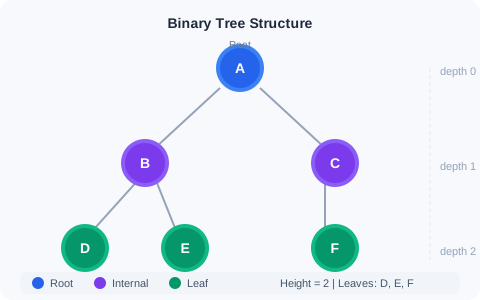
In this tree:
- Height = 2 (longest root-to-leaf path: A → B → D)
- Root = A, Leaves = D, E, F
- B is parent of D and E; D is left child of B, E is right child of B
C++ Node Definition
Throughout this chapter, we use a consistent struct TreeNode:
// Solution: Basic Binary Tree Node
#include <bits/stdc++.h>
using namespace std;

struct TreeNode {
    int val;
    TreeNode* left;
    TreeNode* right;

    // Constructor: initialize with value, no children
    TreeNode(int v) : val(v), left(nullptr), right(nullptr) {}
};
💡 Why raw pointers? In competitive programming, we often manage memory manually for speed.
nullptr(C++11) is always safer than uninitialized pointers — always initializeleft = right = nullptr.
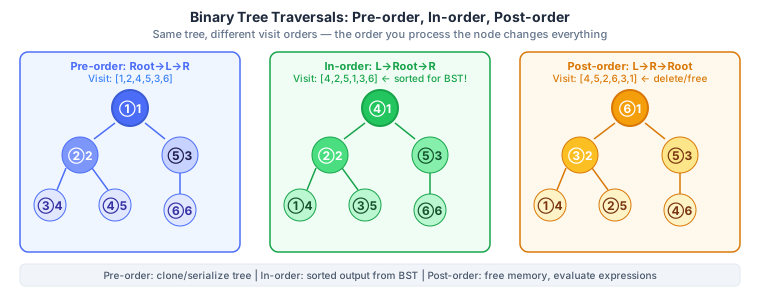
The three traversal orders visit the same tree but in completely different sequences — each has a distinct use case:
3.11.2 Binary Search Trees (BST)
A Binary Search Tree is a binary tree with a crucial ordering property:
BST Property: For every node v:
- All values in the left subtree are strictly less than
v.val - All values in the right subtree are strictly greater than
v.val
       [5]          ← valid BST
      /    \
    [3]    [8]
   /   \   /  \
  [1] [4] [7] [10]

  left of 5 = {1, 3, 4} — all < 5  ✓
  right of 5 = {7, 8, 10} — all > 5  ✓
3.11.2.1 BST Search
// Solution: BST Search — O(log N) average, O(N) worst case
// Returns pointer to node with value 'target', or nullptr if not found
TreeNode* search(TreeNode* root, int target) {
    // Base case: empty tree or found the target
    if (root == nullptr || root->val == target) {
        return root;
    }
    // BST property: go left if target is smaller
    if (target < root->val) {
        return search(root->left, target);
    }
    // Go right if target is larger
    return search(root->right, target);
}
Iterative version (avoids stack overflow for large trees):
// Solution: BST Search Iterative
TreeNode* searchIterative(TreeNode* root, int target) {
    while (root != nullptr) {
        if (target == root->val) return root;       // found
        else if (target < root->val) root = root->left;   // go left
        else root = root->right;                     // go right
    }
    return nullptr;  // not found
}
3.11.2.2 BST Insert
// Solution: BST Insert — O(log N) average
// Returns the (potentially new) root of the subtree
TreeNode* insert(TreeNode* root, int val) {
    // If we've reached a null spot, create the new node here
    if (root == nullptr) {
        return new TreeNode(val);
    }
    if (val < root->val) {
        root->left = insert(root->left, val);   // recurse left
    } else if (val > root->val) {
        root->right = insert(root->right, val); // recurse right
    }
    // val == root->val: duplicate, ignore (or handle as needed)
    return root;
}

// Usage:
// TreeNode* root = nullptr;
// root = insert(root, 5);
// root = insert(root, 3);
// root = insert(root, 8);
3.11.2.3 BST Delete
Deletion is the trickiest BST operation. There are 3 cases:
- Node has no children (leaf): simply delete it
- Node has one child: replace node with its child
- Node has two children: replace with inorder successor (smallest in right subtree), then delete the successor
// Solution: BST Delete — O(log N) average
// Helper: find minimum node in a subtree
TreeNode* findMin(TreeNode* node) {
    while (node->left != nullptr) node = node->left;
    return node;
}

// Delete node with value 'val' from tree rooted at 'root'
TreeNode* deleteNode(TreeNode* root, int val) {
    if (root == nullptr) return nullptr;  // value not found

    if (val < root->val) {
        // Case: target is in left subtree
        root->left = deleteNode(root->left, val);
    } else if (val > root->val) {
        // Case: target is in right subtree
        root->right = deleteNode(root->right, val);
    } else {
        // Found the node to delete!

        // Case 1: No children (leaf)
        if (root->left == nullptr && root->right == nullptr) {
            delete root;
            return nullptr;
        }
        // Case 2a: Only right child
        else if (root->left == nullptr) {
            TreeNode* temp = root->right;
            delete root;
            return temp;
        }
        // Case 2b: Only left child
        else if (root->right == nullptr) {
            TreeNode* temp = root->left;
            delete root;
            return temp;
        }
        // Case 3: Two children — replace with inorder successor
        else {
            TreeNode* successor = findMin(root->right);  // smallest in right subtree
            root->val = successor->val;                  // copy successor's value
            root->right = deleteNode(root->right, successor->val);  // delete successor
        }
    }
    return root;
}
3.11.2.4 BST Degeneration Problem
The diagram below shows a BST insert in action — the search path follows the BST property at each node until finding a null slot:
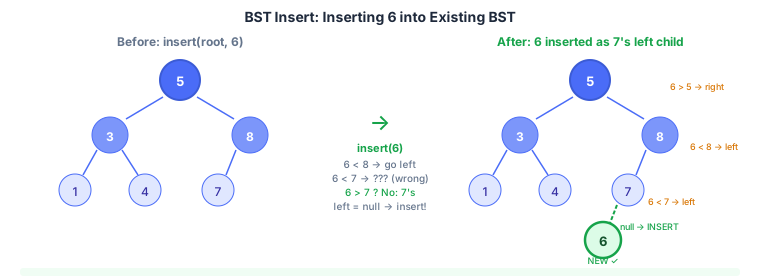
⚠️ Critical Issue: If you insert values in sorted order (1, 2, 3, 4, 5...), the BST becomes a linked list:
[1]
  \
  [2]
    \
    [3]        ← This is O(N) per operation, not O(log N)!
      \
      [4]
        \
        [5]
This is why balanced BSTs (AVL trees, Red-Black trees) exist. In C++, std::set and std::map are implemented as Red-Black trees — always O(log N).
std::set / std::map instead of writing your own BST. They are always balanced. Learn BST fundamentals to understand why they work, then use the STL in contests (see Chapter 3.8).
3.11.3 Tree Traversals
Traversal = visiting every node exactly once. There are 4 fundamental traversals:
| Traversal | Order | Use Case |
|---|---|---|
| Preorder | Root → Left → Right | Copy tree, prefix expression |
| Inorder | Left → Root → Right | Sorted output from BST |
| Postorder | Left → Right → Root | Delete tree, postfix expression |
| Level-order | BFS by depth | Find shortest path, level operations |
3.11.3.1 Preorder Traversal
// Solution: Preorder Traversal — O(N) time, O(H) space (H = height)
// Visit order: Root, Left subtree, Right subtree
void preorder(TreeNode* root) {
    if (root == nullptr) return;   // base case
    cout << root->val << " ";      // process ROOT first
    preorder(root->left);          // then left subtree
    preorder(root->right);         // then right subtree
}

// For the tree:    [5]
//                 /    \
//               [3]    [8]
//              /   \
//            [1]   [4]
// Preorder: 5 3 1 4 8
Iterative Preorder (using stack):
// Solution: Preorder Iterative
void preorderIterative(TreeNode* root) {
    if (root == nullptr) return;
    stack<TreeNode*> stk;
    stk.push(root);

    while (!stk.empty()) {
        TreeNode* node = stk.top(); stk.pop();
        cout << node->val << " ";    // process current

        // Push RIGHT first (so LEFT is processed first — LIFO!)
        if (node->right) stk.push(node->right);
        if (node->left)  stk.push(node->left);
    }
}
3.11.3.2 Inorder Traversal
// Solution: Inorder Traversal — O(N) time
// Visit order: Left subtree, Root, Right subtree
// KEY PROPERTY: Inorder traversal of a BST gives SORTED output!
void inorder(TreeNode* root) {
    if (root == nullptr) return;
    inorder(root->left);           // left subtree first
    cout << root->val << " ";      // then ROOT
    inorder(root->right);          // then right subtree
}

// For BST with values {1, 3, 4, 5, 8}:
// Inorder: 1 3 4 5 8  ← sorted! This is the most important BST property
🔑 Key Insight: Inorder traversal of any BST always produces a sorted sequence. This is why
std::setcan be iterated in sorted order — it uses inorder traversal internally.
Iterative Inorder (slightly trickier):
// Solution: Inorder Iterative
void inorderIterative(TreeNode* root) {
    stack<TreeNode*> stk;
    TreeNode* curr = root;

    while (curr != nullptr || !stk.empty()) {
        // Go as far left as possible
        while (curr != nullptr) {
            stk.push(curr);
            curr = curr->left;
        }
        // Process the leftmost unprocessed node
        curr = stk.top(); stk.pop();
        cout << curr->val << " ";

        // Move to right subtree
        curr = curr->right;
    }
}
3.11.3.3 Postorder Traversal
// Solution: Postorder Traversal — O(N) time
// Visit order: Left subtree, Right subtree, Root
// Used for: deleting trees, evaluating expression trees
void postorder(TreeNode* root) {
    if (root == nullptr) return;
    postorder(root->left);         // left subtree first
    postorder(root->right);        // then right subtree
    cout << root->val << " ";      // ROOT last
}

// For BST [1, 3, 4, 5, 8]:
// Postorder: 1 4 3 8 5  (root 5 is always last)

// ── Memory cleanup using postorder ──
void deleteTree(TreeNode* root) {
    if (root == nullptr) return;
    deleteTree(root->left);   // delete left first
    deleteTree(root->right);  // then right
    delete root;              // then this node (safe: children already deleted)
}
3.11.3.4 Level-Order Traversal (BFS)
// Solution: Level-Order Traversal (BFS) — O(N) time, O(W) space (W = max width)
// Uses a queue: process nodes level by level
void levelOrder(TreeNode* root) {
    if (root == nullptr) return;

    queue<TreeNode*> q;
    q.push(root);

    while (!q.empty()) {
        int levelSize = q.size();  // number of nodes at current level

        for (int i = 0; i < levelSize; i++) {
            TreeNode* node = q.front(); q.pop();
            cout << node->val << " ";

            if (node->left)  q.push(node->left);
            if (node->right) q.push(node->right);
        }
        cout << "\n";  // newline between levels
    }
}

// For the BST [5, 3, 8, 1, 4]:
// Level 0: 5
// Level 1: 3 8
// Level 2: 1 4
Traversal Summary Table
Tree:           [5]
               /    \
             [3]    [8]
            /   \   /
          [1]  [4] [7]

Preorder:   5 3 1 4 8 7
Inorder:    1 3 4 5 7 8    ← sorted!
Postorder:  1 4 3 7 8 5
Level-order: 5 | 3 8 | 1 4 7
3.11.4 Tree Height and Balance
3.11.4.1 Computing Tree Height
// Solution: Tree Height — O(N) time, O(H) space for recursion stack
// Height = length of longest root-to-leaf path
// Convention: height of null tree = -1, leaf node height = 0
int height(TreeNode* root) {
    if (root == nullptr) return -1;  // empty subtree has height -1

    int leftHeight  = height(root->left);   // height of left subtree
    int rightHeight = height(root->right);  // height of right subtree

    return 1 + max(leftHeight, rightHeight);  // +1 for current node
}
// Time: O(N) — visit every node exactly once
// Space: O(H) — recursion stack depth = tree height

// Alternative: some define height as number of nodes on longest path
// Then: leaf has height 1, and empty tree has height 0
// Be careful about which convention your problem uses!
3.11.4.2 Checking Balance
A balanced binary tree requires that for every node, the heights of its left and right subtrees differ by at most 1.
// Solution: Check Balanced BST — O(N) time
// Returns -1 if unbalanced, otherwise returns the height of subtree
int checkBalanced(TreeNode* root) {
    if (root == nullptr) return 0;  // empty is balanced, height 0

    int leftH = checkBalanced(root->left);
    if (leftH == -1) return -1;     // left subtree is unbalanced

    int rightH = checkBalanced(root->right);
    if (rightH == -1) return -1;    // right subtree is unbalanced

    // Check balance at current node: heights can differ by at most 1
    if (abs(leftH - rightH) > 1) return -1;  // unbalanced!

    return 1 + max(leftH, rightH);   // return height if balanced
}

bool isBalanced(TreeNode* root) {
    return checkBalanced(root) != -1;
}
3.11.4.3 Counting Nodes
// Solution: Count Nodes — O(N)
int countNodes(TreeNode* root) {
    if (root == nullptr) return 0;
    return 1 + countNodes(root->left) + countNodes(root->right);
}

// Count leaves specifically
int countLeaves(TreeNode* root) {
    if (root == nullptr) return 0;
    if (root->left == nullptr && root->right == nullptr) return 1;  // leaf!
    return countLeaves(root->left) + countLeaves(root->right);
}
3.11.5 Lowest Common Ancestor (LCA) — Brute Force
The LCA of two nodes u and v in a rooted tree is the deepest node that is an ancestor of both.
          [1]
         /    \
       [2]    [3]
      /   \      \
    [4]   [5]   [6]
   /
  [7]

LCA(4, 5) = 2     (both 4 and 5 are descendants of 2)
LCA(4, 6) = 1     (deepest common ancestor is the root 1)
LCA(2, 4) = 2     (node 2 is ancestor of 4 and ancestor of itself)
O(N) Brute Force LCA
// Solution: LCA Brute Force — O(N) per query
// Strategy: find path from root to each node, then find last common node

// Step 1: Find path from root to target node
bool findPath(TreeNode* root, int target, vector<int>& path) {
    if (root == nullptr) return false;

    path.push_back(root->val);  // add current node to path

    if (root->val == target) return true;  // found target!

    // Try left then right
    if (findPath(root->left, target, path)) return true;
    if (findPath(root->right, target, path)) return true;

    path.pop_back();  // backtrack: target not in this subtree
    return false;
}

// Step 2: Find LCA using two paths
int lca(TreeNode* root, int u, int v) {
    vector<int> pathU, pathV;

    findPath(root, u, pathU);   // path from root to u
    findPath(root, v, pathV);   // path from root to v

    // Find last common node in both paths
    int result = root->val;
    int minLen = min(pathU.size(), pathV.size());

    for (int i = 0; i < minLen; i++) {
        if (pathU[i] == pathV[i]) {
            result = pathU[i];  // still common
        } else {
            break;  // diverged
        }
    }
    return result;
}
💡 USACO Note: For USACO Silver problems, the
O(N)brute force LCA is NOT always sufficient. With N ≤ 10^5 nodes and Q ≤ 10^5 queries, the total isO(NQ)=O(10^10)— too slow. Use it only when N, Q ≤ 5000. Chapter 5.3 coversO(log N)LCA with binary lifting for harder problems.
3.11.6 Complete BST Implementation
Here's a complete, contest-ready BST with all operations:
// Solution: Complete BST Implementation
#include <bits/stdc++.h>
using namespace std;

struct TreeNode {
    int val;
    TreeNode* left;
    TreeNode* right;
    TreeNode(int v) : val(v), left(nullptr), right(nullptr) {}
};

struct BST {
    TreeNode* root;
    BST() : root(nullptr) {}

    // ── Insert ──
    TreeNode* _insert(TreeNode* node, int val) {
        if (!node) return new TreeNode(val);
        if (val < node->val) node->left  = _insert(node->left,  val);
        else if (val > node->val) node->right = _insert(node->right, val);
        return node;
    }
    void insert(int val) { root = _insert(root, val); }

    // ── Search ──
    bool search(int val) {
        TreeNode* curr = root;
        while (curr) {
            if (val == curr->val) return true;
            curr = (val < curr->val) ? curr->left : curr->right;
        }
        return false;
    }

    // ── Inorder (sorted output) ──
    void _inorder(TreeNode* node, vector<int>& result) {
        if (!node) return;
        _inorder(node->left, result);
        result.push_back(node->val);
        _inorder(node->right, result);
    }
    vector<int> getSorted() {
        vector<int> result;
        _inorder(root, result);
        return result;
    }

    // ── Height ──
    int _height(TreeNode* node) {
        if (!node) return -1;
        return 1 + max(_height(node->left), _height(node->right));
    }
    int height() { return _height(root); }
};

int main() {
    ios_base::sync_with_stdio(false);
    cin.tie(NULL);

    BST bst;
    vector<int> vals = {5, 3, 8, 1, 4, 7, 10};
    for (int v : vals) bst.insert(v);

    cout << "Sorted: ";
    for (int v : bst.getSorted()) cout << v << " ";
    cout << "\n";
    // Output: 1 3 4 5 7 8 10

    cout << "Height: " << bst.height() << "\n";  // 2
    cout << "Search 4: " << bst.search(4) << "\n";  // 1 (true)
    cout << "Search 6: " << bst.search(6) << "\n";  // 0 (false)

    return 0;
}
3.11.7 USACO-Style Practice Problem
Problem: "Cow Family Tree" (USACO Bronze Style)
Problem Statement:
Farmer John has N cows numbered 1 to N. Cow 1 is the ancestor of all cows (the "root"). For each cow i (2 ≤ i ≤ N), its parent is cow parent[i]. The depth of a cow is defined as the number of edges from the root (cow 1) to that cow (so cow 1 has depth 0).
Given the tree and M queries, each asking "what is the depth of cow x?", answer all queries.
Input:
- Line 1: N, M (1 ≤ N, M ≤ 100,000)
- Lines 2 to N: each line contains
i parent[i] - Next M lines: each contains a single integer
x
Output: For each query, print the depth of cow x.
📋 Sample Input/Output (8 lines, click to expand)
Sample Input:
5 3
2 1
3 1
4 2
5 3
4
5
1
Sample Output:
2
2
0
Solution Approach: Use DFS/BFS to compute depth of each node.
// Solution: Cow Family Tree — Depth Query
#include <bits/stdc++.h>
using namespace std;

const int MAXN = 100005;
vector<int> children[MAXN];  // adjacency list: children[i] = list of i's children
int depth[MAXN];             // depth[i] = depth of node i

// DFS to compute depths
void dfs(int node, int d) {
    depth[node] = d;
    for (int child : children[node]) {
        dfs(child, d + 1);  // children have depth+1
    }
}

int main() {
    ios_base::sync_with_stdio(false);
    cin.tie(NULL);

    int n, m;
    cin >> n >> m;

    for (int i = 2; i <= n; i++) {
        int par;
        cin >> par;
        children[par].push_back(i);  // par is parent of i
    }

    dfs(1, 0);  // start DFS from root (cow 1) at depth 0

    while (m--) {
        int x;
        cin >> x;
        cout << depth[x] << "\n";
    }

    return 0;
}
// Time: O(N + M)
// Space: O(N)
💡 Extension: What if we want sum of values on path to root?
// Instead of depth, compute path sum (sum of node values on path to root)
int pathSum[MAXN];  // pathSum[i] = sum of values from root to i
int nodeVal[MAXN];  // nodeVal[i] = value of node i

void dfs(int node, int cumSum) {
    pathSum[node] = cumSum + nodeVal[node];
    for (int child : children[node]) {
        dfs(child, pathSum[node]);
    }
}
// Query: just return pathSum[x] in O(1)
3.11.8 Building a Tree from Traversals
A classic problem: given preorder and inorder traversals, reconstruct the original tree.
Key insight:
- The first element of preorder is always the root
- In the inorder array, the root splits it into left and right subtrees
// Solution: Reconstruct Tree from Preorder + Inorder — O(N^2) naive
TreeNode* build(vector<int>& pre, int preL, int preR,
                vector<int>& in,  int inL,  int inR) {
    if (preL > preR) return nullptr;

    int rootVal = pre[preL];  // first preorder element = root
    TreeNode* root = new TreeNode(rootVal);

    // Find root in inorder array
    int rootIdx = inL;
    while (in[rootIdx] != rootVal) rootIdx++;

    int leftSize = rootIdx - inL;  // number of nodes in left subtree

    // Recursively build left and right subtrees
    root->left  = build(pre, preL+1, preL+leftSize, in, inL, rootIdx-1);
    root->right = build(pre, preL+leftSize+1, preR, in, rootIdx+1, inR);

    return root;
}

TreeNode* buildTree(vector<int>& preorder, vector<int>& inorder) {
    int n = preorder.size();
    return build(preorder, 0, n-1, inorder, 0, n-1);
}
⚠️ Common Mistakes
// BAD: No null check!
void inorder(TreeNode* root) {
    inorder(root->left);  // CRASH if root is null
    cout << root->val;
    inorder(root->right);
}
// GOOD: Base case first
void inorder(TreeNode* root) {
    if (root == nullptr) return;  // ← critical!
    inorder(root->left);
    cout << root->val;
    inorder(root->right);
}
// BAD: Recursive DFS on a 10^5 node
// degenerate tree (skewed) = 10^5 recursion depth
// Default stack ~ 8MB = overflow around 10^4-10^5!
void dfsRecursive(TreeNode* root) {
    if (!root) return;
    process(root);
    dfsRecursive(root->left);
    dfsRecursive(root->right);
}
// GOOD: Use explicit stack for large trees
void dfsIterative(TreeNode* root) {
    stack<TreeNode*> stk;
    if (root) stk.push(root);
    while (!stk.empty()) {
        TreeNode* node = stk.top(); stk.pop();
        process(node);
        if (node->right) stk.push(node->right);
        if (node->left)  stk.push(node->left);
    }
}
Top 5 BST/Tree Bugs
- Forgetting
nullptrbase case — causes segfault immediately - Not returning the (potentially new) root from insert/delete — tree structure broken
- Stack overflow — use iterative traversal for N > 10^5
- Memory leak — always
deletenodes you remove (or use smart pointers) - Using unbalanced BST when STL set would work — use
std::setin contests
Chapter Summary
📌 Key Takeaways
| Concept | Key Point | Time Complexity |
|---|---|---|
| BST Search | Follow left/right based on comparison | O(log N) avg, O(N) worst |
| BST Insert | Find correct position, insert at null | O(log N) avg |
| BST Delete | 3 cases: leaf, one child, two children | O(log N) avg |
| Inorder | Left → Root → Right | O(N) |
| Preorder | Root → Left → Right | O(N) |
| Postorder | Left → Right → Root | O(N) |
| Level-order | BFS by level | O(N) |
| Height | max(leftH, rightH) + 1 | O(N) |
| Balance Check | leftH - rightH | |
| LCA (brute) | Find paths, compare | O(N) per query |
❓ FAQ
Q1: When should I use BST vs std::set?
A: In competitive programming, almost always use
std::set.std::setis backed by a red-black tree (balanced BST), guaranteeingO(log N); a hand-written BST may degenerate toO(N). Only consider writing your own BST when you need custom BST behavior (e.g., tracking subtree sizes for "K-th largest" queries), or use__gnu_pbds::tree(Policy-Based Data Structure).
Q2: What is the relationship between Segment Tree and BST?
A: Segment Tree (Chapter 3.9) is a complete binary tree, but not a BST—nodes store range aggregate values (like range sums), not ordered keys. Both are binary trees with similar structure, but completely different purposes. Understanding BST pointer/recursion operations makes Segment Tree code easier to understand.
Q3: Which traversal—preorder/inorder/postorder—is most common in contests?
A: Inorder is most important—it outputs the BST's sorted sequence. Postorder is common for tree DP (compute children before parent). Level-order (BFS) is used when processing by level. Preorder is less common, but useful for serializing/deserializing trees.
Q4: Which is better, recursive or iterative implementation?
A: Recursive code is concise and easy to understand (preferred in contests). But when N ≥ 10^5 and the tree may degenerate, recursion risks stack overflow (default stack ~8MB, supports ~10^4~10^5 levels). USACO problems usually have non-degenerate trees, so recursion is usually fine; but if unsure, iterative is safer.
Q5: How important is LCA in competitive programming?
A: Very important! LCA is the foundation of tree DP and path queries. It appears occasionally in USACO Silver and is almost always tested in USACO Gold. The
O(N)brute-force LCA learned here handles N ≤ 5000. TheO(log N)Binary Lifting LCA is covered in detail in Chapter 5.3 (Trees & Special Graphs).
🔗 Connections to Other Chapters
- Chapter 2.3 (Functions & Arrays): foundation of recursion—binary tree traversal is a perfect application of recursion
- Chapter 3.8 (Maps & Sets):
std::set/std::mapare backed by balanced BST; understanding BST helps you use them better - Chapter 3.9 (Segment Trees): Segment Tree is a complete binary tree; the recursive structure of build/query/update is identical to BST traversal
- Chapter 5.2 (Graph Algorithms): trees are special undirected graphs (connected, acyclic); all tree algorithms are special cases of graph algorithms
- Chapter 5.3 (Trees & Special Graphs): LCA Binary Lifting, Euler Tour—built directly on this chapter's foundation
Practice Problems
Problem 3.11.1 — BST Validator 🟢 Easy Given a binary tree (not necessarily a BST), determine if it satisfies the BST property.
Hint
Common mistake: only checking `root->left->val < root->val` is NOT enough. Pass `minVal` and `maxVal` bounds down the recursion.✅ Full Solution
Core Idea: Pass allowed (min, max) range down. Every node must lie strictly inside its range.
#include <bits/stdc++.h>
using namespace std;
struct TreeNode { int val; TreeNode *left, *right; };

bool isValidBST(TreeNode* root, long long lo, long long hi) {
    if (!root) return true;
    if (root->val <= lo || root->val >= hi) return false;
    return isValidBST(root->left, lo, root->val)
        && isValidBST(root->right, root->val, hi);
}
// Usage: isValidBST(root, LLONG_MIN, LLONG_MAX);
Why the min/max bounds? Because a node in the right subtree of root must be > root, even if it's a left child of some ancestor. Only passing direct parent is not enough.
Complexity: O(N) time, O(H) recursion stack.
Problem 3.11.2 — BST Inorder K-th Smallest 🟢 Easy Find the K-th smallest element in a BST.
Hint
Inorder traversal visits nodes in sorted order. Stop when K nodes visited.✅ Full Solution
#include <bits/stdc++.h>
using namespace std;
struct TreeNode { int val; TreeNode *left, *right; };

int count_ = 0, result = -1;
void inorder(TreeNode* root, int k) {
    if (!root || result != -1) return;
    inorder(root->left, k);
    if (++count_ == k) { result = root->val; return; }
    inorder(root->right, k);
}
Using iterative inorder (avoids global variables):
int kthSmallest(TreeNode* root, int k) {
    stack<TreeNode*> st;
    TreeNode* cur = root;
    while (cur || !st.empty()) {
        while (cur) { st.push(cur); cur = cur->left; }
        cur = st.top(); st.pop();
        if (--k == 0) return cur->val;
        cur = cur->right;
    }
    return -1;
}
Complexity: O(H + K) — much better than O(N) for small K.
Problem 3.11.3 — Tree Diameter 🟡 Medium Find the longest path between any two nodes (does not need to pass through root).
Hint
For each node, longest path through it = leftHeight + rightHeight. Single DFS: return height, update a global diameter.✅ Full Solution
Core Idea: Post-order DFS. Each node computes: (a) its own height for the parent, (b) the best path passing through it (updates global answer).
#include <bits/stdc++.h>
using namespace std;
struct TreeNode { int val; TreeNode *left, *right; };

int diameter = 0;
int height(TreeNode* root) {
    if (!root) return 0;
    int L = height(root->left);
    int R = height(root->right);
    diameter = max(diameter, L + R);  // path through this node: L edges + R edges
    return 1 + max(L, R);              // height to parent
}
// Answer: diameter (in edges). For "nodes", diameter+1.
Why does this work? The diameter must pass through some "peak" node — the highest node on the path. That peak's contribution = height(left) + height(right). We visit every node as a potential peak.
Complexity: O(N).
Problem 3.11.4 — Flatten BST / Median of BST 🟡 Medium Given a BST with N nodes, find the median cow score (the ⌈N/2⌉-th smallest value).
Hint
Inorder traversal gives sorted array. Return element at index (N-1)/2.✅ Full Solution
#include <bits/stdc++.h>
using namespace std;
struct TreeNode { int val; TreeNode *left, *right; };

void inorder(TreeNode* root, vector<int>& arr) {
    if (!root) return;
    inorder(root->left, arr);
    arr.push_back(root->val);
    inorder(root->right, arr);
}

int findMedian(TreeNode* root) {
    vector<int> arr;
    inorder(root, arr);
    return arr[(arr.size() - 1) / 2];  // lower median for even N
}
Optimization for large trees: use Problem 3.11.2's kth-smallest approach directly — no need to flatten: kthSmallest(root, (n+1)/2). Saves O(N) memory.
Complexity: O(N) time and space (or O(H + N/2) with kth-smallest approach).
Problem 3.11.5 — Maximum Path Sum 🔴 Hard Nodes can have negative values. Find the path (between any two nodes) with maximum sum.
Hint
For each node v: best path through v = max(0, left_max_down) + max(0, right_max_down) + v->val. Negative branches clamped to 0.✅ Full Solution
Core Idea: DFS returns "best one-sided path starting at this node going down". Global answer considers "best two-sided path rooted at this node". Clamp negative sub-paths to 0 (don't include them).
#include <bits/stdc++.h>
using namespace std;
struct TreeNode { int val; TreeNode *left, *right; };

int bestSum = INT_MIN;
int maxGain(TreeNode* root) {
    if (!root) return 0;
    // Clamp to 0: we can choose NOT to include the subtree if it's negative
    int L = max(0, maxGain(root->left));
    int R = max(0, maxGain(root->right));

    // Best path WITH root as turning point
    bestSum = max(bestSum, root->val + L + R);

    // Return one-sided path to parent (can only choose one branch)
    return root->val + max(L, R);
}
// Answer: bestSum after calling maxGain(root)
Key insight: A path is a "V" shape — it goes up to some peak, then down. Each node is considered as the peak exactly once.
Trace example:
      -10
     /    \
    9      20
          /  \
         15   7

maxGain(9)=9, maxGain(15)=15, maxGain(7)=7
maxGain(20): L=15, R=7, best=20+15+7=42 ✓, returns 20+15=35
maxGain(-10): L=9, R=35, best=max(42, -10+9+35)=42, returns max(-10+35, -10+9)=25
Answer: 42 (path 15 → 20 → 7)
Complexity: O(N).
End of Chapter 3.11 — Next: Chapter 4.1: Greedy Fundamentals