Chapter 3.1: STL Essentials
📝 Prerequisites: Chapters 2.1–2.3 (variables, loops, functions, vectors)
The Standard Template Library (STL) is C++'s built-in collection of ready-made data structures and algorithms. Instead of writing your own linked lists, hash tables, or sorting algorithms from scratch, you use the STL — it's fast, reliable, and tested by millions of programmers.
Learning to pick the right STL container for a problem is one of the most important skills in competitive programming.
What you'll learn in this chapter:
sort— sort any sequence in one line, with custom rulespair— bundle two values together cleanlymap/set— ordered key-value store and unique-element collectionstack/queue— LIFO and FIFO containers for classic algorithmspriority_queue— always get the max (or min) in O(log N)unordered_map/unordered_set— hash-based O(1) lookupautoand range-basedfor— write cleaner, shorter code- Useful STL algorithms:
binary_search,lower_bound,accumulate, and more
3.1.0 The STL Toolbox
Think of the STL as a toolbox. Each tool is designed for a specific job:
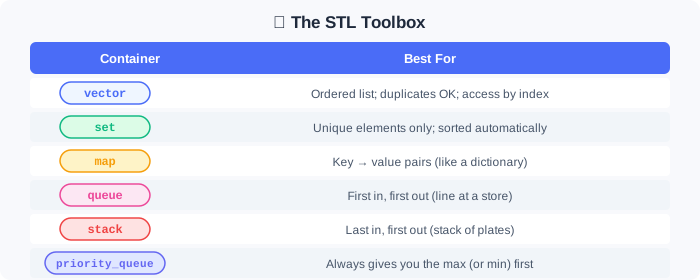
Quick reference — which container to reach for:
| Need | Use |
|---|---|
| Ordered list, random access | vector |
| Two values bundled together | pair |
| Key → value mapping (sorted) | map |
| Unique elements (sorted) | set |
| Key → value mapping (fast, unsorted) | unordered_map |
| Unique elements (fast, unsorted) | unordered_set |
| LIFO (last in, first out) | stack |
| FIFO (first in, first out) | queue |
| Always get the max/min quickly | priority_queue |
Picking the right tool = half the solution in competitive programming!
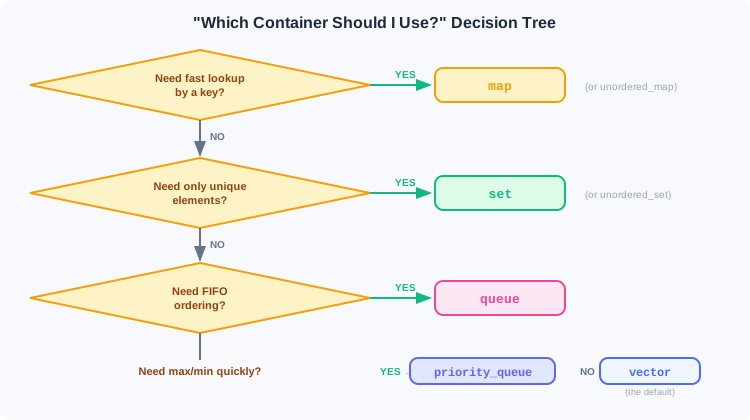
"Which Container Should I Use?" Decision Tree
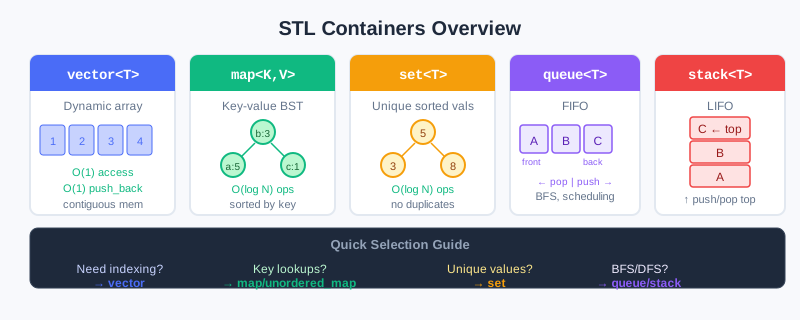
Visual: STL Containers Overview
3.1.1 sort — The Only Sort You Need
We start with sort because you'll use it in almost every problem.
What it is and why it matters
Sorting rearranges a sequence of elements into order. Rather than implementing your own sorting algorithm (which is error-prone and takes time), C++'s sort is:
- Fast: O(N log N) — the theoretical best for comparison-based sorting
- Easy to use: one line of code
- Flexible: sorts by any rule you define
⚠️ Important:
sortrequires#include <algorithm>(included automatically via#include <bits/stdc++.h>).
#include <bits/stdc++.h>
using namespace std;

int main() {
    // Sorting a vector — ascending (default)
    vector<int> v = {5, 2, 8, 1, 9, 3};
    sort(v.begin(), v.end());
    // v is now: {1, 2, 3, 5, 8, 9}

    for (int x : v) cout << x << " ";
    cout << "\n";

    // Sorting descending
    sort(v.begin(), v.end(), greater<int>());
    // v is now: {9, 8, 5, 3, 2, 1}

    // Sorting an array
    int arr[] = {4, 2, 7, 1, 5};
    int n = 5;
    sort(arr, arr + n);  // sorts arr[0..n-1]
    // arr is now: {1, 2, 4, 5, 7}

    return 0;
}
Custom Sort (Lambda Functions)
What if you want to sort by something other than the natural order? Use a lambda — a small inline function:
vector<int> v = {5, -3, 2, -8, 1};

// Sort by absolute value
sort(v.begin(), v.end(), [](int a, int b) {
    return abs(a) < abs(b);  // return true if a should come BEFORE b
});
// v is now: {1, 2, -3, 5, -8}  (ordered by |value|)
The lambda [](int a, int b) { return ...; } is the comparison rule. It must return true if a should come before b in the sorted result.
🐛 Common mistake: Never return
truewhena == b— this violates the "strict weak ordering" rule and causes undefined behavior (crash or wrong answer). Always use<or>, never<=or>=.
// Sort a vector of pairs: by second element (descending), then first element (ascending)
vector<pair<int,int>> pts = {{3,5},{1,7},{2,5},{4,3}};
sort(pts.begin(), pts.end(), [](pair<int,int> a, pair<int,int> b) {
    if (a.second != b.second) return a.second > b.second;  // bigger second first
    return a.first < b.first;   // tie-break: smaller first first
});
// Result: {1,7}, {2,5}, {3,5}, {4,3}
3.1.2 pair — Storing Two Values Together
A pair bundles two values into one object. Think of it as a "mini-struct" for two values.
Why use pair? Often you need to keep two related values together — like (value, index), (x-coordinate, y-coordinate), or (score, name). pair does this cleanly.
#include <bits/stdc++.h>
using namespace std;

int main() {
    // Create a pair
    pair<int, int> point = {3, 5};         // (x, y)
    pair<string, int> student = {"Alice", 95};  // (name, score)

    // Access elements: .first and .second
    cout << point.first << " " << point.second << "\n";    // 3 5
    cout << student.first << ": " << student.second << "\n"; // Alice: 95

    // Pairs support comparison: compares .first first, then .second
    pair<int,int> a = {1, 3};
    pair<int,int> b = {1, 5};
    cout << (a < b) << "\n";   // 1 (true) — same .first, so compare .second: 3 < 5

    // Very common pattern: sort by second element using pairs
    vector<pair<int,int>> v = {{3,9},{1,2},{4,1},{1,5}};
    sort(v.begin(), v.end());     // sorts by .first first, then .second
    // Result: {1,2}, {1,5}, {3,9}, {4,1}

    return 0;
}
⚡ Pro Tip: When you need to sort items by one value but keep track of their original index, store them as
pair<value, index>and sort. After sorting,.secondgives you the original index.
💡
make_pairvs brace initialization: Bothmake_pair(3, 5)and{3, 5}create a pair. The brace syntax{3, 5}is shorter and preferred in modern C++ (C++11 and later).
3.1.3 map — The Dictionary
A map stores key-value pairs, like a real dictionary: given a word (key), look up its definition (value). Each key appears at most once.
When to use map
- Counting frequencies: word → count, score → frequency
- Mapping IDs to names: student_id → name
- Storing properties: cow_name → milk_production
#include <bits/stdc++.h>
using namespace std;

int main() {
    map<string, int> phoneBook;

    // Insert key-value pairs
    phoneBook["Alice"] = 555001;
    phoneBook["Bob"] = 555002;
    phoneBook["Charlie"] = 555003;

    // Lookup by key
    cout << phoneBook["Alice"] << "\n";  // 555001

    // Iterate (always in SORTED KEY order!)
    for (auto& entry : phoneBook) {
        cout << entry.first << " -> " << entry.second << "\n";
    }
    // Prints:
    // Alice -> 555001
    // Bob -> 555002
    // Charlie -> 555003

    // Erase a key
    phoneBook.erase("Charlie");
    cout << phoneBook.size() << "\n";  // 2

    return 0;
}
Common Operations with Time Complexity
| Operation | Code | Time |
|---|---|---|
| Insert/update | m[key] = value | O(log n) |
| Lookup | m[key] or m.at(key) | O(log n) |
| Check existence | m.count(key) or m.find(key) | O(log n) |
| Delete | m.erase(key) | O(log n) |
| Size | m.size() | O(1) |
| Iterate all | range-for | O(n) |
🐛 The map Access Gotcha
This is one of the most common map bugs:
map<string, int> freq;

// DANGER: accessing a non-existent key CREATES IT with value 0!
cout << freq["apple"] << "\n";  // prints 0, but now "apple" is IN the map!
cout << freq.size() << "\n";    // 1 — even though we only "looked", not "inserted"!

// SAFE way 1: check count first
if (freq.count("apple") > 0) {
    cout << freq["apple"] << "\n";  // safe — key exists
}

// SAFE way 2: use .find()
auto it = freq.find("apple");
if (it != freq.end()) {          // .end() means "not found"
    cout << it->second << "\n";  // it->second is the value
}
Frequency Counting — The Most Common map Pattern
vector<string> words = {"apple", "banana", "apple", "cherry", "banana", "apple"};
map<string, int> freq;

for (const string& w : words) {
    freq[w]++;  // if "w" doesn't exist, it's created with 0, then incremented to 1
}

// freq: apple→3, banana→2, cherry→1
for (auto& p : freq) {
    cout << p.first << " appears " << p.second << " times\n";
}
💡 Why
freq[w]++works even for new keys:mapdefault-initializes missing values. Forint, the default is0. So accessing a new key creates it with value0, and++makes it1. This is intentional and widely used for counting.
3.1.4 set — Unique Sorted Collection
A set stores unique elements in sorted order. Insert a duplicate — it's silently ignored.
When to use set
- Removing duplicates from a list
- Checking membership quickly: "have I seen this value before?"
- Getting the minimum/maximum of a dynamic collection
#include <bits/stdc++.h>
using namespace std;

int main() {
    set<int> s;

    s.insert(5);
    s.insert(2);
    s.insert(8);
    s.insert(2);   // duplicate — ignored! set stays {2, 5, 8}
    s.insert(1);

    // s is now: {1, 2, 5, 8}  (automatically sorted, no duplicates)

    // Check membership
    cout << s.count(2) << "\n";   // 1 (exists)
    cout << s.count(7) << "\n";   // 0 (not there)

    // Erase
    s.erase(2);   // s = {1, 5, 8}

    // Iterate (always sorted)
    for (int x : s) cout << x << " ";
    cout << "\n";   // 1 5 8

    // Min and max
    cout << *s.begin() << "\n";   // 1 (smallest; * dereferences the iterator)
    cout << *s.rbegin() << "\n";  // 8 (largest; r = reverse)

    cout << s.size() << "\n";  // 3

    return 0;
}
Common Operations with Time Complexity
| Operation | Code | Time |
|---|---|---|
| Insert | s.insert(x) | O(log n) |
| Check existence | s.count(x) or s.find(x) | O(log n) |
| Delete | s.erase(x) | O(log n) |
| Min | *s.begin() | O(1) |
| Max | *s.rbegin() | O(1) |
| Size | s.size() | O(1) |
Deduplication with set
vector<int> v = {3, 1, 4, 1, 5, 9, 2, 6, 5, 3, 5};
set<int> unique_set(v.begin(), v.end());  // construct set from vector
// unique_set = {1, 2, 3, 4, 5, 6, 9}

cout << "Unique count: " << unique_set.size() << "\n";   // 7

// Convert back to sorted vector if needed:
vector<int> deduped(unique_set.begin(), unique_set.end());
💡
setvsmultiset:setstores each value at most once. If you need to store duplicates but still want sorted order, usemultiset<int>— it allows repeated elements.
3.1.5 stack — Last In, First Out
A stack works like a pile of plates: you can only add to the top or remove from the top. The last item added is the first one removed (LIFO: Last In, First Out).
When to use stack
- Matching brackets/parentheses
- Undo/redo history
- Depth-first search (DFS) — covered in later chapters
- Reversing a sequence
#include <bits/stdc++.h>
using namespace std;

int main() {
    stack<int> st;

    st.push(1);    // [1]         (top is on the right)
    st.push(2);    // [1, 2]
    st.push(3);    // [1, 2, 3]

    cout << st.top() << "\n";   // 3 (peek at top without removing)
    st.pop();                    // remove top → [1, 2]
    cout << st.top() << "\n";   // 2

    cout << st.size() << "\n";  // 2
    cout << st.empty() << "\n"; // 0 (not empty)

    return 0;
}
Common Operations with Time Complexity
| Operation | Code | Time |
|---|---|---|
| Push to top | st.push(x) | O(1) |
| Remove from top | st.pop() | O(1) |
| Peek at top | st.top() | O(1) |
| Check if empty | st.empty() | O(1) |
| Size | st.size() | O(1) |
🐛 Common Stack Mistake: Pop Without Checking
stack<int> st;
// st.top();  // CRASH! Can't peek at top of empty stack
// st.pop();  // CRASH! Can't pop from empty stack

// Always check before accessing:
if (!st.empty()) {
    cout << st.top() << "\n";
    st.pop();
}
Classic Stack Problem: Balanced Parentheses
string expr = "((a+b)*(c-d))";
stack<char> parens;
bool balanced = true;

for (char ch : expr) {
    if (ch == '(') {
        parens.push(ch);         // opening: push onto stack
    } else if (ch == ')') {
        if (parens.empty()) {    // closing with no matching opening
            balanced = false;
            break;
        }
        parens.pop();            // match found: pop the opening
    }
}

if (!parens.empty()) balanced = false;  // unmatched opening parens remain

cout << (balanced ? "Balanced" : "Not balanced") << "\n";
3.1.6 queue — First In, First Out
A queue works like a line at a store: you join at the back and leave from the front. The first person who joined is the first to be served (FIFO: First In, First Out).
When to use queue
- Simulating a line of customers, processes, tasks
- Breadth-first search (BFS) — one of the most important algorithms in competitive programming (Chapter 5.2)
- Processing items in the order they arrived
#include <bits/stdc++.h>
using namespace std;

int main() {
    queue<int> q;

    q.push(10);   // [10]
    q.push(20);   // [10, 20]
    q.push(30);   // [10, 20, 30]

    cout << q.front() << "\n";  // 10 (first in line — will leave first)
    cout << q.back() << "\n";   // 30 (last in line — will leave last)

    q.pop();                     // remove from front → [20, 30]
    cout << q.front() << "\n";  // 20

    cout << q.size() << "\n";   // 2

    return 0;
}
Common Operations with Time Complexity
| Operation | Code | Time |
|---|---|---|
| Add to back | q.push(x) | O(1) |
| Remove from front | q.pop() | O(1) |
| Peek front | q.front() | O(1) |
| Peek back | q.back() | O(1) |
| Check if empty | q.empty() | O(1) |
Note: You'll use
queueextensively in Chapter 5.2 for BFS — one of the most important graph algorithms for USACO.
🐛 Common mistake:
queuehas notop()method (that'sstack). Usefront()to peek at the front element andback()to peek at the rear.
3.1.7 priority_queue — The Heap
A priority_queue is like a magic queue: no matter what order you insert things, it always gives you the largest element first (max-heap by default).
When to use priority_queue
- Always need the largest (or smallest) element quickly
- Finding the K largest numbers
- Dijkstra's shortest path algorithm (Chapter 5.4)
- Greedy algorithms where you always process the "best" item next
#include <bits/stdc++.h>
using namespace std;

int main() {
    // Max-heap: always gives you the MAXIMUM
    priority_queue<int> maxPQ;

    maxPQ.push(5);
    maxPQ.push(1);
    maxPQ.push(8);
    maxPQ.push(3);

    // Pop in decreasing order
    while (!maxPQ.empty()) {
        cout << maxPQ.top() << " ";  // always the current max
        maxPQ.pop();
    }
    cout << "\n";  // prints: 8 5 3 1

    return 0;
}
🐛 The Min-Heap Gotcha
By default, priority_queue is a max-heap (gives largest first). For a min-heap (gives smallest first), you need a special syntax:
// MAX-heap (default) — gives LARGEST first
priority_queue<int> maxPQ;

// MIN-heap — gives SMALLEST first (note the extra template arguments!)
priority_queue<int, vector<int>, greater<int>> minPQ;

minPQ.push(5);
minPQ.push(1);
minPQ.push(8);
minPQ.push(3);

while (!minPQ.empty()) {
    cout << minPQ.top() << " ";
    minPQ.pop();
}
// prints: 1 3 5 8  (smallest first)
Common Operations with Time Complexity
| Operation | Code | Time |
|---|---|---|
| Insert | pq.push(x) | O(log n) |
| Get max/min | pq.top() | O(1) |
| Remove max/min | pq.pop() | O(log n) |
| Check if empty | pq.empty() | O(1) |
💡 Priority queue with pairs: You can store
pair<int, int>in a priority queue. It compares by.firstfirst, then.second— useful for Dijkstra's algorithm where you store{distance, node}.priority_queue<pair<int,int>, vector<pair<int,int>>, greater<pair<int,int>>> minPQ; // min-heap of (distance, node) pairs — used in Dijkstra
3.1.8 unordered_map and unordered_set — Hash-Based Speed
The regular map and set are sorted (using a balanced binary search tree internally), giving O(log N) operations. The unordered_ variants use a hash table for O(1) average time — faster, but no guaranteed ordering.
💡 Underlying Principle: Why is map O(log N) while unordered_map is O(1)?
map/setinternally use a red-black tree (a self-balancing binary search tree). Each insert, find, or delete traverses from root to leaf, with tree height ≈ log₂N, hence O(log N). Advantage: elements are always sorted, supportinglower_boundand range queries.unordered_map/unordered_setinternally use a hash table. The hash function directly computes the storage location, averaging O(1). But element order is not guaranteed, and worst case can degrade to O(N) (with severe hash collisions).- Contest experience: If you only need lookup/insert without ordered traversal, prefer
unordered_map. But if you get TLE from worst-caseunordered_mapbehavior (being hacked), switching back tomapis the safest choice.
unordered_map<string, int> freq;
freq["apple"]++;
freq["banana"]++;
freq["apple"]++;

cout << freq["apple"] << "\n";   // 2 (same interface as map)

unordered_set<int> seen;
seen.insert(5);
seen.insert(10);
cout << seen.count(5) << "\n";   // 1 (found)
cout << seen.count(7) << "\n";   // 0 (not found)
Hack-Resistant unordered_map
In competitive programming, adversaries can craft inputs that cause many hash collisions, degrading unordered_map to O(N) per operation. A simple defense is to use a custom hash:
// Add this before main() to make unordered_map harder to hack
struct custom_hash {
    size_t operator()(long long x) const {
        x = (x ^ (x >> 30)) * 0xbf58476d1ce4e5b9LL;
        x = (x ^ (x >> 27)) * 0x94d049bb133111ebLL;
        return x ^ (x >> 31);
    }
};
unordered_map<long long, int, custom_hash> safe_map;
For most problems, the default unordered_map is fine. Use the custom hash only when you suspect anti-hash tests.
When to use which
| Container | When to use |
|---|---|
map / set | Need sorted order; need lower_bound; small N; safety first |
unordered_map / unordered_set | Only need lookup; N is large (> 10⁵); keys are strings or ints |
⚡ Pro Tip:
unordered_mapcan be 5-10× faster thanmapfor large inputs with string keys. But it has rare "worst case" behavior that can be exploited in competitive programming — usemapif you're getting TLE withunordered_mapand suspect a hack.
3.1.9 The auto Keyword and Range-Based For
C++ can often figure out the type of a variable automatically. The auto keyword tells the compiler: "you figure out the type."
auto x = 42;          // x is int
auto y = 3.14;        // y is double
auto v = vector<int>{1, 2, 3};  // v is vector<int>

map<string, int> freq;
auto it = freq.find("cat");  // type would be map<string,int>::iterator — very long!
// auto saves you from writing that
⚠️
autopitfall:autodeduces the type at compile time — it doesn't make variables dynamically typed. Also,auto x = 1000000000 * 2;deducesintand may overflow; writeauto x = 1000000000LL * 2;to getlong long.
Range-Based For
Clean iteration over any container:
vector<int> nums = {10, 20, 30, 40, 50};

// Read-only iteration (copies each element — fine for int, wasteful for string)
for (int x : nums) {
    cout << x << " ";
}

// Reference: no copy, can modify elements
for (int& x : nums) {
    x *= 2;   // doubles each element in-place
}

// Const reference: no copy, read-only (best for large types like string)
for (const auto& x : nums) {
    cout << x << " ";
}
Rule of thumb for range-based for:
- Small types (
int,char):for (int x : v)— copy is fine - Large types (
string,pair, structs):for (const auto& x : v)— avoid copying - Need to modify:
for (auto& x : v)
3.1.10 Useful STL Algorithms
These functions from <algorithm> and <numeric> work on any sequence:
#include <bits/stdc++.h>
using namespace std;

int main() {
    vector<int> v = {3, 1, 4, 1, 5, 9, 2, 6};

    // Sort ascending
    sort(v.begin(), v.end());
    // v = {1, 1, 2, 3, 4, 5, 6, 9}

    // Binary search (on SORTED sequence only!)
    cout << binary_search(v.begin(), v.end(), 5) << "\n";  // 1 (found)
    cout << binary_search(v.begin(), v.end(), 7) << "\n";  // 0 (not found)

    // lower_bound: first position where value >= target
    auto it = lower_bound(v.begin(), v.end(), 4);
    cout << *it << "\n";   // 4
    cout << (it - v.begin()) << "\n";  // index: 3

    // upper_bound: first position where value > target
    auto it2 = upper_bound(v.begin(), v.end(), 4);
    cout << (it2 - v.begin()) << "\n";  // index: 4 (first element > 4)
    // Elements in range [lo, hi]: upper_bound(hi+1) - lower_bound(lo)

    // Min and max
    cout << *min_element(v.begin(), v.end()) << "\n";  // 1
    cout << *max_element(v.begin(), v.end()) << "\n";  // 9

    // Sum of all elements
    long long total = accumulate(v.begin(), v.end(), 0LL);
    cout << total << "\n";  // 31

    // Count occurrences
    cout << count(v.begin(), v.end(), 1) << "\n";  // 2

    // Reverse
    reverse(v.begin(), v.end());

    // Fill with a value
    fill(v.begin(), v.end(), 0);  // all zeros

    return 0;
}
3.1.11 Putting It All Together: Word Frequency Counter
Let's build a complete mini-program that uses map, vector, and sort together.
Problem: Read N words, count how many times each word appears, then print:
- All words and their counts in alphabetical order
- The most frequently appearing word
#include <bits/stdc++.h>
using namespace std;

int main() {
    ios_base::sync_with_stdio(false);
    cin.tie(NULL);

    int n;
    cin >> n;

    // Step 1: Count word frequencies using a map
    map<string, int> freq;
    for (int i = 0; i < n; i++) {
        string word;
        cin >> word;
        freq[word]++;   // if word is new, creates entry with 0, then increments
    }

    // Step 2: Print all words in alphabetical order (map iterates in sorted key order)
    cout << "All words:\n";
    for (auto& entry : freq) {
        // entry.first = word, entry.second = count
        cout << entry.first << ": " << entry.second << "\n";
    }

    // Step 3: Find the most frequent word
    // max_element on the map: compare by value (.second)
    auto best = max_element(
        freq.begin(),
        freq.end(),
        [](const pair<string,int>& a, const pair<string,int>& b) {
            return a.second < b.second;  // compare by count
        }
    );

    cout << "\nMost frequent: \"" << best->first << "\" (appears "
         << best->second << " times)\n";

    return 0;
}
Sample Input:
10
the cat sat on the mat the cat sat on
Sample Output:
All words:
cat: 2
mat: 1
on: 2
sat: 2
the: 3

Most frequent: "the" (appears 3 times)
Complexity Analysis:
- Time: O(N log N) — each
freq[word]++is O(log N), N times total;max_elementtraverses the map in O(M), where M is the number of distinct words- Space: O(M) — map stores M distinct words
🤔 Why does iterating over
mapgive alphabetical order?mapinternally uses a balanced BST (binary search tree), which keeps keys sorted. So when you iterate, you always get keys in sorted order automatically — no extra sorting needed!
💡 Alternative for finding max: Instead of
max_elementon the map, you could also transfer entries to avector<pair<string,int>>, sort by.seconddescending, and take the first element. Both approaches are O(M) after counting.
Chapter Summary
📌 Key Takeaways
| Container | Description | Key Operations | Time | Why It Matters |
|---|---|---|---|---|
vector<T> | Dynamic array | push_back, [], size | O(1) amortized | Most commonly used container, default choice |
pair<A,B> | Store two values | .first, .second | O(1) | Graph edges, coordinates, etc. |
map<K,V> | Ordered key-value pairs | [], find, count | O(log n) | Frequency counting, ordered mapping |
set<T> | Ordered unique set | insert, count, erase | O(log n) | Deduplication, range queries |
stack<T> | Last-in first-out | push, pop, top | O(1) | Bracket matching, DFS |
queue<T> | First-in first-out | push, pop, front | O(1) | BFS, simulation |
priority_queue<T> | Max-heap | push, pop, top | O(log n) | Greedy max/min, Dijkstra |
unordered_map<K,V> | Hash map (unsorted) | [], find, count | O(1) avg | Fast lookup for large data |
unordered_set<T> | Hash set (unsorted) | insert, count, erase | O(1) avg | Fast membership check, dedup |
❓ FAQ
Q1: What is the difference between vector and a plain array? When to use which?
A:
vectorcan grow dynamically (push_back), knows its own size (.size()), and can be safely passed to functions. Plain arrays have fixed size but are slightly faster (global arrays auto-initialize to 0). In contests, usevectorfor most cases; global large arrays (likeint dp[100001]) are sometimes more convenient as C arrays.
Q2: When to choose map vs unordered_map?
A: If you only need lookup/insert/delete, use
unordered_map(O(1)) for speed. If you need ordered traversal orlower_bound/upper_bound, usemap(O(log N)). In contests without special requirements,mapis safer (cannot be hacked).
Q3: Is priority_queue a max-heap or min-heap by default?
A: Max-heap.
pq.top()returns the maximum element. For a min-heap, declare aspriority_queue<int, vector<int>, greater<int>>.
Q4: When is a custom struct better than pair?
A:
pair's.first/.secondhave poor readability — three months later you may forget what.firstmeans.structlets you give members meaningful names (like.weight,.value). When data has 3 or more fields,structis necessary.
Q5: Why does sort on a vector<pair<int,int>> sort by .first first?
A:
pairhas a built-inoperator<that compares.firstfirst; if equal, it compares.second. This is called lexicographic order — the same way words are sorted in a dictionary. You can rely on this behavior without writing a custom comparator.
Q6: What's the difference between s.count(x) and s.find(x) != s.end() for a set?
A: For
setandmap, both are O(log N) and functionally equivalent for checking existence.countreturns 0 or 1 (sets have no duplicates), whilefindreturns an iterator you can use to access the element directly. Preferfindwhen you also need to read the value; prefercountfor a simple yes/no check.
🔗 Connections to Later Chapters
- Chapter 3.4 (Monotonic Stack & Queue): monotonic stack for next-greater-element problems; monotonic deque for sliding window max/min
- Chapter 3.6 (Stacks & Queues): deep dive into
stackandqueuealgorithm applications — bracket matching, BFS - Chapter 3.8 (Maps & Sets): advanced usage of
map/set— frequency counting,multiset - Chapter 3.3 (Sorting):
sortwith custom comparators used withvectorandpair priority_queueappears frequently in Chapter 4.1 (Greedy) and Chapter 5.3 (Kruskal MST)- The STL containers in this chapter are the foundational tools for all subsequent chapters in this book
Practice Problems
🌡️ Warm-Up Problems
Warm-up 3.1.1 — Set Membership
Read N integers, then read Q queries. For each query, read one integer and print YES if it appeared in the original N integers, NO otherwise.
📋 Sample Input/Output (6 lines, click to expand)
Sample Input:
5
10 20 30 40 50
3
20
35
50
Sample Output:
YES
NO
YES
💡 Solution (click to reveal)
Approach: Store the N integers in a set, then for each query check s.count(x).
#include <bits/stdc++.h>
using namespace std;

int main() {
    ios_base::sync_with_stdio(false);
    cin.tie(NULL);

    int n;
    cin >> n;

    set<int> s;
    for (int i = 0; i < n; i++) {
        int x;
        cin >> x;
        s.insert(x);
    }

    int q;
    cin >> q;
    while (q--) {
        int x;
        cin >> x;
        cout << (s.count(x) ? "YES" : "NO") << "\n";
    }

    return 0;
}
Key points:
s.count(x)returns 1 if x is in the set, 0 if notwhile (q--)is a common idiom: runs the loop q times (q decrements each time)- Using a set gives O(log N) per query vs O(N) for a linear search
Warm-up 3.1.2 — Character Frequency Read a string (no spaces). Print each character that appears in it along with its count, in alphabetical order.
Sample Input: hello
Sample Output:
e: 1
h: 1
l: 2
o: 1
💡 Solution (click to reveal)
Approach: Use a map<char, int> to count character frequencies. Iterating over the map gives alphabetical order automatically.
#include <bits/stdc++.h>
using namespace std;

int main() {
    string s;
    cin >> s;

    map<char, int> freq;
    for (char c : s) {
        freq[c]++;
    }

    for (auto& entry : freq) {
        cout << entry.first << ": " << entry.second << "\n";
    }

    return 0;
}
Key points:
for (char c : s)iterates over each character in the stringfreq[c]++creates the entry with value 0 on first access, then increments it- Map iteration is always in sorted key order — so characters come out alphabetically
Warm-up 3.1.3 — Reverse with Stack
Read a string (no spaces). Use a stack to print the string in reverse.
Sample Input: hello → Sample Output: olleh
💡 Solution (click to reveal)
Approach: Push each character onto a stack. Then pop them all — LIFO order gives reverse order.
#include <bits/stdc++.h>
using namespace std;

int main() {
    string s;
    cin >> s;

    stack<char> st;
    for (char c : s) {
        st.push(c);
    }

    while (!st.empty()) {
        cout << st.top();
        st.pop();
    }
    cout << "\n";

    return 0;
}
Key points:
- Stack's LIFO property: last character pushed is first popped = reversal
- Always check
!st.empty()before accessingst.top()or callingst.pop() - Note:
reverse(s.begin(), s.end()); cout << s;is simpler — but using a stack teaches the concept
Warm-up 3.1.4 — Queue Simulation Simulate a line of exactly 5 people. Their names are: Alice, Bob, Charlie, Dave, Eve. They join in that order. Serve them one at a time (pop from front) and print each name as they're served.
Expected Output:
Serving: Alice
Serving: Bob
Serving: Charlie
Serving: Dave
Serving: Eve
💡 Solution (click to reveal)
Approach: Push all names into a queue, then pop and print until empty.
#include <bits/stdc++.h>
using namespace std;

int main() {
    queue<string> line;
    line.push("Alice");
    line.push("Bob");
    line.push("Charlie");
    line.push("Dave");
    line.push("Eve");

    while (!line.empty()) {
        cout << "Serving: " << line.front() << "\n";
        line.pop();
    }

    return 0;
}
Key points:
queue.front()accesses the first element WITHOUT removing itqueue.pop()removes the front element (no return value — usefront()beforepop()if you need the value)- Queue maintains insertion order — first pushed is first popped
Warm-up 3.1.5 — Top 3 Largest
Read N integers. Using a priority_queue, find and print the 3 largest values (in descending order).
Sample Input:
7
5 1 9 3 7 2 8
Sample Output:
9
8
7
💡 Solution (click to reveal)
Approach: Push all into a max-heap priority_queue. Pop 3 times to get the 3 largest.
#include <bits/stdc++.h>
using namespace std;

int main() {
    int n;
    cin >> n;

    priority_queue<int> pq;
    for (int i = 0; i < n; i++) {
        int x;
        cin >> x;
        pq.push(x);
    }

    for (int i = 0; i < 3 && !pq.empty(); i++) {
        cout << pq.top() << "\n";
        pq.pop();
    }

    return 0;
}
Key points:
priority_queue<int>is a max-heap —top()always gives the largest- We pop 3 times to get the 3 largest in order
- The
&& !pq.empty()guard handles the edge case where N < 3
🏋️ Core Practice Problems
Problem 3.1.6 — Unique Elements Read N integers. Print only the unique values, in the order they first appeared (not sorted). If a value appears more than once, print it only on its first occurrence.
📋 Sample Input/Output (113 lines, click to expand)
Sample Input:
8
3 1 4 1 5 9 2 6
Sample Output: 3 1 4 5 9 2 6
(Note: 1 appears twice but is printed only once, at its first position.)
💡 Solution (click to reveal)
Approach: Use an unordered_set to track which values we've seen. For each element, print it only if we haven't seen it yet.
#include <bits/stdc++.h>
using namespace std;

int main() {
    ios_base::sync_with_stdio(false);
    cin.tie(NULL);

    int n;
    cin >> n;

    unordered_set<int> seen;
    bool first = true;

    for (int i = 0; i < n; i++) {
        int x;
        cin >> x;
        if (seen.count(x) == 0) {   // haven't seen x yet
            seen.insert(x);
            if (!first) cout << " ";
            cout << x;
            first = false;
        }
    }
    cout << "\n";

    return 0;
}
Key points:
- We can't use a regular
setbecause set would sort the output — we want original order unordered_setgives O(1) average lookup: much faster than searching a vector- The
firstflag handles spacing (no leading/trailing space)
Problem 3.1.7 — Most Frequent Word Read N words. Print the word that appears most often. If there's a tie, print the alphabetically smallest word.
Sample Input:
7
apple banana apple cherry banana apple cherry
Sample Output: apple
💡 Solution (click to reveal)
Approach: Count with map, then find the maximum count. Among all words with that count, pick the alphabetically smallest (which map iteration naturally gives us).
#include <bits/stdc++.h>
using namespace std;

int main() {
    ios_base::sync_with_stdio(false);
    cin.tie(NULL);

    int n;
    cin >> n;

    map<string, int> freq;
    for (int i = 0; i < n; i++) {
        string w;
        cin >> w;
        freq[w]++;
    }

    string bestWord;
    int bestCount = 0;

    // Map iterates in sorted (alphabetical) order — so first word we see with max count wins
    for (auto& entry : freq) {
        if (entry.second > bestCount) {
            bestCount = entry.second;
            bestWord = entry.first;
        }
    }

    cout << bestWord << "\n";
    return 0;
}
Key points:
- Using
>(strictly greater) means we keep the FIRST word that achieves the max count - Since
mapiterates alphabetically, the first max-count word seen is the alphabetically smallest one - Tie-breaking is handled automatically because of map's sorted property
Problem 3.1.8 — Pair Sum Read N integers and a target T. For each pair of values (a, b) where a appears before b in the input and a + b = T, print the pair. Use a set for an O(N) solution.
Sample Input:
6 9
1 8 3 6 4 5
Sample Output:
1 8
3 6
4 5
💡 Solution (click to reveal)
Approach: For each element x, check if T - x is already in a set of previously seen elements. If yes, we found a pair.
#include <bits/stdc++.h>
using namespace std;

int main() {
    ios_base::sync_with_stdio(false);
    cin.tie(NULL);

    int n, t;
    cin >> n >> t;

    set<int> seen;
    vector<int> arr(n);
    for (int i = 0; i < n; i++) cin >> arr[i];

    for (int i = 0; i < n; i++) {
        int complement = t - arr[i];  // we need arr[i] + complement = t
        if (seen.count(complement)) {
            // complement came before arr[i], print in order: complement arr[i]
            cout << complement << " " << arr[i] << "\n";
        }
        seen.insert(arr[i]);
    }

    return 0;
}
Key points:
- For each element x, the "complement" needed is
T - x - If the complement is already in our "seen" set, it came earlier in the array → valid pair
- This is O(N log N) with set (or O(N) with unordered_set) vs O(N²) for the brute force
- We print
complementfirst (it appeared earlier in input) thenarr[i]
Problem 3.1.9 — Bracket Matching
Read a string containing only (, ), [, ], {, }. Print YES if all brackets are properly matched and nested, NO otherwise.
Sample Input 1: {[()]} → Output: YES
Sample Input 2: ([)] → Output: NO
Sample Input 3: ((() → Output: NO
💡 Solution (click to reveal)
Approach: Use a stack. Push opening brackets. When we see a closing bracket, check if the top of the stack is the matching opening bracket.
#include <bits/stdc++.h>
using namespace std;

int main() {
    string s;
    cin >> s;

    stack<char> st;
    bool ok = true;

    for (char ch : s) {
        if (ch == '(' || ch == '[' || ch == '{') {
            st.push(ch);    // opening: push
        } else {
            // closing bracket
            if (st.empty()) {
                ok = false;  // no matching opening
                break;
            }
            char top = st.top();
            st.pop();

            // Check if it matches
            if ((ch == ')' && top != '(') ||
                (ch == ']' && top != '[') ||
                (ch == '}' && top != '{')) {
                ok = false;
                break;
            }
        }
    }

    if (!st.empty()) ok = false;  // leftover unmatched opening brackets

    cout << (ok ? "YES" : "NO") << "\n";
    return 0;
}
Key points:
- The key insight: the most recently opened bracket must be the next one to close
- Stack's LIFO property perfectly models this "most recent opening" requirement
- Three failure conditions: (1) closing bracket with empty stack, (2) mismatched bracket type, (3) leftover unclosed brackets at end
Problem 3.1.10 — Top K Elements Read N integers and K. Print the K largest values in descending order.
Sample Input:
8 3
4 9 1 7 3 5 2 8
Sample Output:
9
8
7
💡 Solution (click to reveal)
Approach: Push all into a max-heap, then pop K times.
#include <bits/stdc++.h>
using namespace std;

int main() {
    ios_base::sync_with_stdio(false);
    cin.tie(NULL);

    int n, k;
    cin >> n >> k;

    priority_queue<int> pq;
    for (int i = 0; i < n; i++) {
        int x;
        cin >> x;
        pq.push(x);
    }

    for (int i = 0; i < k && !pq.empty(); i++) {
        cout << pq.top() << "\n";
        pq.pop();
    }

    return 0;
}
Key points:
- Priority queue automatically keeps the maximum at the top
- Each
pop()removes the current maximum, revealing the next largest - Alternative: sort in descending order and take first K — same result
🏆 Challenge Problems
Challenge 3.1.11 — Inventory System Process M commands on a store inventory. Each command is one of:
ADD name quantity— addquantityunits of productnameREMOVE name quantity— removequantityunits (if removing more than available, set to 0)QUERY name— print current quantity ofname(0 if never added)
📋 Sample Input/Output (7 lines, click to expand)
Sample Input:
6
ADD apple 10
ADD banana 5
QUERY apple
REMOVE apple 3
QUERY apple
QUERY grape
Sample Output:
10
7
0
💡 Solution (click to reveal)
Approach: Use a map<string, long long> as the inventory. Process each command by parsing the type and updating accordingly.
#include <bits/stdc++.h>
using namespace std;

int main() {
    ios_base::sync_with_stdio(false);
    cin.tie(NULL);

    int m;
    cin >> m;

    map<string, long long> inventory;

    while (m--) {
        string cmd;
        cin >> cmd;

        if (cmd == "ADD") {
            string name;
            long long qty;
            cin >> name >> qty;
            inventory[name] += qty;
        } else if (cmd == "REMOVE") {
            string name;
            long long qty;
            cin >> name >> qty;
            inventory[name] -= qty;
            if (inventory[name] < 0) inventory[name] = 0;
        } else {  // QUERY
            string name;
            cin >> name;
            // Use count to avoid creating an entry for missing items
            if (inventory.count(name)) {
                cout << inventory[name] << "\n";
            } else {
                cout << 0 << "\n";
            }
        }
    }

    return 0;
}
Key points:
inventory[name] += qty— ifnamedoesn't exist, it's created with 0 then has qty added (correct!)- For QUERY, use
inventory.count(name)to check existence before accessing — avoids silently creating a 0 entry long longfor quantities in case they're large
Challenge 3.1.12 — Sliding Window Maximum Read N integers and a window size K. Print the maximum value in each window of K consecutive elements.
Sample Input:
8 3
1 3 -1 -3 5 3 6 7
Sample Output:
3
3
5
5
6
7
(Windows: [1,3,-1]→3, [3,-1,-3]→3, [-1,-3,5]→5, [-3,5,3]→5, [5,3,6]→6, [3,6,7]→7)
💡 Solution (click to reveal)
Approach: Use a deque (double-ended queue) to maintain a window of useful indices. The deque stores indices in decreasing order of their values — so deque.front() is always the index of the current window's maximum.
#include <bits/stdc++.h>
using namespace std;

int main() {
    ios_base::sync_with_stdio(false);
    cin.tie(NULL);

    int n, k;
    cin >> n >> k;

    vector<int> arr(n);
    for (int i = 0; i < n; i++) cin >> arr[i];

    deque<int> dq;  // stores indices, front = index of current maximum

    for (int i = 0; i < n; i++) {
        // Remove indices that are out of the current window
        while (!dq.empty() && dq.front() < i - k + 1) {
            dq.pop_front();
        }

        // Remove indices of elements smaller than arr[i] from the back
        // (they can never be the maximum while arr[i] is in the window)
        while (!dq.empty() && arr[dq.back()] <= arr[i]) {
            dq.pop_back();
        }

        dq.push_back(i);

        // Print maximum for windows that are full (starting from index k-1)
        if (i >= k - 1) {
            cout << arr[dq.front()] << "\n";
        }
    }

    return 0;
}
Key points:
- The deque maintains a "decreasing monotone queue" of indices
- Front of deque = index of the maximum in current window
- When we add new element
arr[i]: remove from back all elements ≤arr[i](they're useless — arr[i] is larger and will stay in window longer) - Remove from front when that index is no longer in the window (index < i - k + 1)
- This gives O(N) total — each index is pushed and popped at most once
Challenge 3.1.13 — Haybales Range Count (USACO Bronze style)
N haybales are placed at various positions on a number line. Process Q queries: for each query (L, R), print how many haybales have positions in the range [L, R] inclusive.
📋 Sample Input/Output (6 lines, click to expand)
Sample Input:
5 4
3 1 7 5 2
1 3
2 6
4 8
1 10
Sample Output:
3
3
2
5
💡 Solution (click to reveal)
Approach: Sort the positions. For each query, use lower_bound and upper_bound to find the count in range [L, R] in O(log N).
#include <bits/stdc++.h>
using namespace std;

int main() {
    ios_base::sync_with_stdio(false);
    cin.tie(NULL);

    int n, q;
    cin >> n >> q;

    vector<int> pos(n);
    for (int i = 0; i < n; i++) cin >> pos[i];

    sort(pos.begin(), pos.end());  // must sort for binary search to work

    while (q--) {
        int l, r;
        cin >> l >> r;

        // lower_bound(l): first position >= l
        // upper_bound(r): first position > r
        // Elements in [l, r] = count between these two iterators
        auto lo = lower_bound(pos.begin(), pos.end(), l);
        auto hi = upper_bound(pos.begin(), pos.end(), r);

        cout << (hi - lo) << "\n";  // distance between iterators = count
    }

    return 0;
}
Key points:
- Sort the positions first — required for binary search
lower_bound(pos.begin(), pos.end(), l)returns an iterator to the first element ≥ lupper_bound(pos.begin(), pos.end(), r)returns an iterator to the first element > r- The count of elements in [l, r] = distance between these two iterators =
hi - lo - This is O(N log N) for sorting + O(Q log N) for queries — much better than O(N×Q) brute force
Looking Ahead: Beyond Basic STL
This chapter covered the core STL containers you'll use in 90% of problems. As you progress, you'll encounter more specialized structures:
deque<T>— double-ended queue; supports O(1) push/pop at both front and back. Used in the sliding window maximum problem (Challenge 3.1.12) and monotonic deque (Chapter 3.4).multiset<T>— likesetbut allows duplicate elements. Useful when you need sorted order with repeats.bitset<N>— fixed-size sequence of bits; extremely fast for subset/membership problems.- Trie (prefix tree) — stores strings by sharing common prefixes, enabling O(L) lookup where L is string length.
Visual: Trie Data Structure
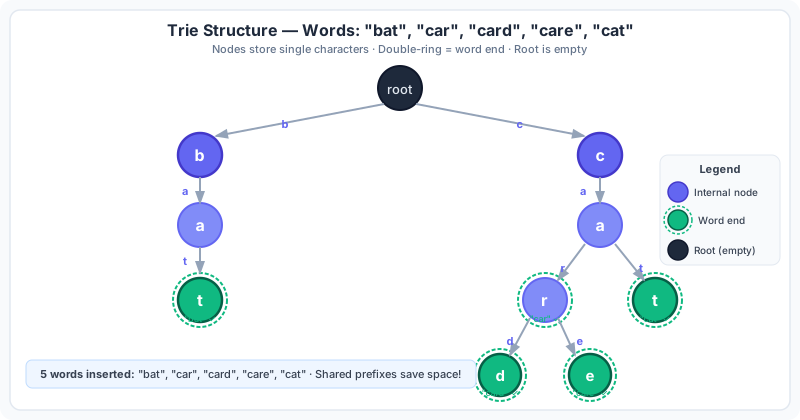
A trie (prefix tree) stores strings by sharing common prefixes. Words "bat", "car", "card", "care", "cat" share prefixes efficiently: "ca" is stored once, branching to "r" and "t". Double-ringed nodes mark word endings. Tries are used for autocomplete, spell checking, and string matching. For string hashing alternatives, see Chapter 3.7 (Hashing Techniques).