Chapter 5.1: Introduction to Graphs
📝 Before You Continue: You should be comfortable with arrays, vectors, and basic C++ (Chapters 2–4). Familiarity with
struct(Chapter 2.4) and STL containers likevectorandpair(Chapter 3.1) will be helpful.
Think of a graph as a map: cities are nodes, roads between them are edges. Graphs are the most versatile data structure in competitive programming — they model friendships between people, dependencies between tasks, cells in a maze, and much more. In USACO, nearly every problem at Silver level and above involves graphs in some form.
This chapter teaches you how to think in graphs and, more importantly, how to store them in code. By the end, you'll be able to read any USACO graph input and choose the right representation without hesitation.
5.1.1 What Is a Graph?
A graph G = (V, E) consists of two sets:
- Vertices V (also called nodes): the "things" — cities, cows, cells, states
- Edges E: the connections between them — roads, friendships, transitions
We write |V| = N for the number of vertices and |E| = M for the number of edges.
How Do We Store a Graph?
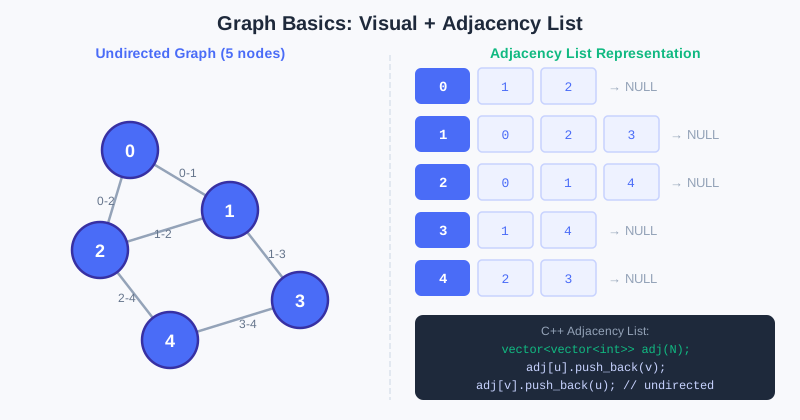
Before diving into terminology, let's get a quick preview of how graphs are stored in code. There are two main approaches (we'll cover them in detail in §5.1.2):
Adjacency List — For each vertex, store a list of its neighbors. This is the most common representation:
adj[0] = {1, 2}        ← node 0 connects to 1 and 2
adj[1] = {0, 2, 3}     ← node 1 connects to 0, 2, and 3
adj[2] = {0, 1, 4}     ← node 2 connects to 0, 1, and 4
adj[3] = {1, 4}         ← node 3 connects to 1 and 4
adj[4] = {2, 3}         ← node 4 connects to 2 and 3
Adjacency Matrix — Use a V×V grid where adj[u][v] = 1 means "edge exists between u and v":
adj:   0  1  2  3  4
  0  [ 0  1  1  0  0 ]     ← node 0 connects to 1 and 2
  1  [ 1  0  1  1  0 ]     ← node 1 connects to 0, 2, and 3
  2  [ 1  1  0  0  1 ]     ← node 2 connects to 0, 1, and 4
  3  [ 0  1  0  0  1 ]     ← node 3 connects to 1 and 4
  4  [ 0  0  1  1  0 ]     ← node 4 connects to 2 and 3
💡 Quick comparison: Adjacency list uses less memory and is faster for traversal — use it 95% of the time. Adjacency matrix gives O(1) edge lookup — useful when V is small (≤ 1500) or for algorithms like Floyd-Warshall.
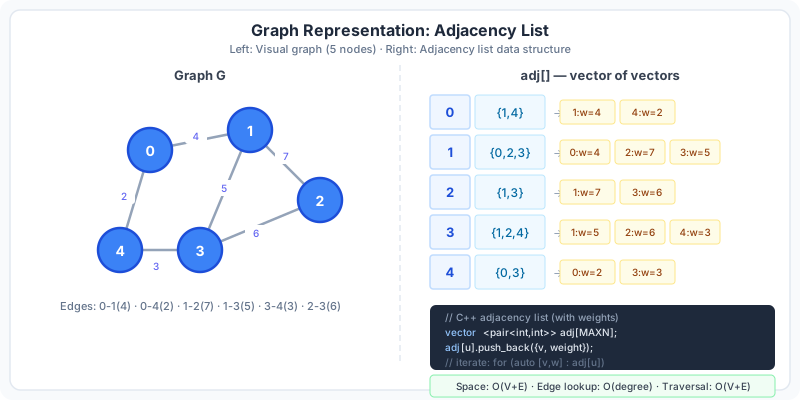
The following two diagrams show the same 5-node graph stored as an adjacency list and an adjacency matrix:
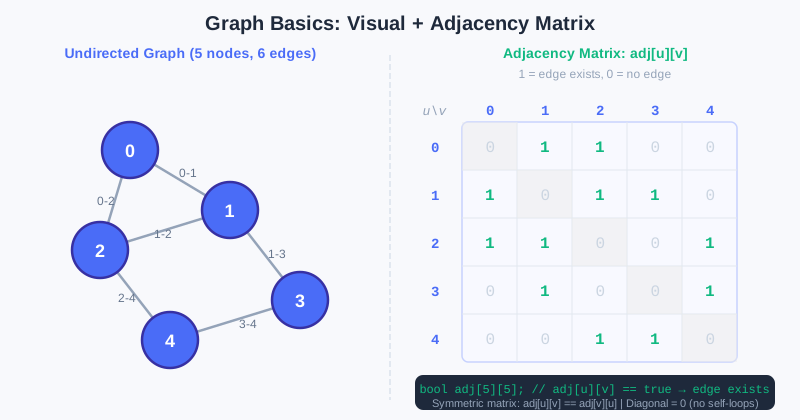
In the matrix, green 1 = edge exists, gray 0 = no edge. The shaded diagonal cells are always 0 (no self-loops). Notice the matrix is symmetric — because the graph is undirected.
Key Terminology
You don't need to memorize all of these right now — just skim them and come back as needed.
| Term | Definition | Example |
|---|---|---|
| Degree | Number of edges touching a vertex | Node 2 has degree 3 |
| Path | Sequence of vertices connected by edges | 1 → 2 → 4 → 6 |
| Cycle | Path that starts and ends at the same vertex | 1 → 2 → 3 → 1 |
| Connected | Every vertex reachable from every other | One component |
| Component | Maximal connected subgraph | A "cluster" of nodes |
| Sparse | Few edges: M = O(V) | Road networks |
| Dense | Many edges: M = O(V²) | Complete graphs |
Handshaking Lemma
The sum of all vertex degrees equals 2M (twice the number of edges).
Proof: each edge (u, v) contributes exactly +1 to deg(u) and +1 to deg(v).
Implication: The number of odd-degree vertices in any graph is always even. This can immediately rule out impossible cases in problems.
Types of Graphs
Graphs come in several flavors. Here are the ones you'll encounter most often:
| Type | Description | USACO Frequency |
|---|---|---|
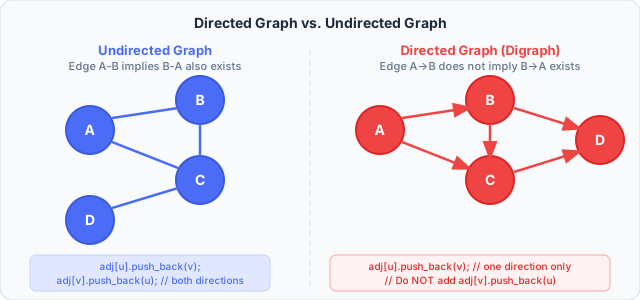
| Undirected | Edge A–B means B–A also; roads, pasture connections | ⭐⭐⭐ Very common |
| Directed (Digraph) | Edge A→B does NOT imply B→A; dependencies, flow | ⭐⭐ Common (Gold+) |
| Weighted | Each edge has a numeric cost; road distances | ⭐⭐⭐ Common (Silver+) |
| Tree | Connected, acyclic, exactly N−1 edges | ⭐⭐⭐ Very common all levels |
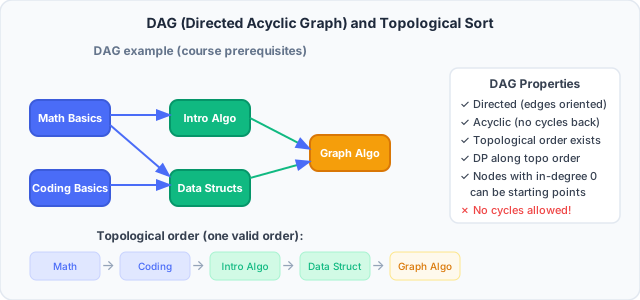
| DAG | Directed Acyclic Graph; topological order exists | ⭐⭐ Common for DP states |
| Grid Graph | Cells are nodes, 4-directional edges; mazes | ⭐⭐⭐ Most common Bronze/Silver |
| Complete Graph K_n | Every pair connected; N(N−1)/2 edges | ⭐ Rare; usually theoretical |
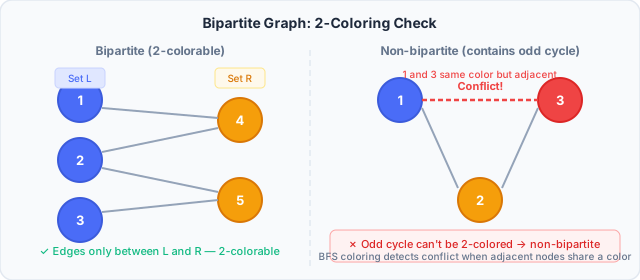
| Bipartite | Two-color vertices, edges only cross groups | ⭐⭐ Matching, 2-coloring |
USACO reality: Bronze/Silver mostly uses unweighted undirected graphs and grid graphs. Weighted graphs appear in Silver shortest paths. Trees appear at all levels. Gold introduces DAGs, directed graphs, and dense graphs.
5.1.2 Graph Representation
Now that you know what a graph is, the next question is: how do you store it in code? This is the most critical coding decision for graph problems. Three main representations exist, each with different trade-offs. Choosing wrongly leads to TLE or MLE.
Representation 1: Adjacency List — The Default Choice
For each vertex, store a list of its neighbors. This is the go-to representation for 95% of USACO problems.
#include <bits/stdc++.h>
using namespace std;

int main() {
    ios_base::sync_with_stdio(false);
    cin.tie(NULL);

    int n, m;          // n vertices (1..n), m edges
    cin >> n >> m;

    // adj[u] = list of vertices directly connected to u
    vector<vector<int>> adj(n + 1);  // size n+1 to use 1-indexed vertices

    for (int i = 0; i < m; i++) {
        int u, v;
        cin >> u >> v;
        adj[u].push_back(v);  // undirected: add BOTH directions
        adj[v].push_back(u);
    }

    // Traverse all neighbors of vertex u: O(deg(u)) — optimal
    for (int u = 1; u <= n; u++) {
        cout << u << " -> ";
        for (int v : adj[u]) cout << v << " ";
        cout << "\n";
    }

    return 0;
}
📋 Sample Input/Output (7 lines, click to expand)
Sample Input:
6 6
1 2
1 3
2 4
3 5
4 6
5 6
Sample Output:
1 -> 2 3
2 -> 1 4
3 -> 1 5
4 -> 2 6
5 -> 3 6
6 -> 4 5
Properties:
- Space:
O(V + E)— optimal. For V = 10^5, E = 2×10^5 easily fits in 256 MB. - Iterate neighbors:
O(deg(u))— only visits actual neighbors, never wasted work. - Check edge (u, v):
O(deg(u))— must scan neighbor list. (This is the weakness.) - Cache performance:
vectoruses contiguous memory → 5–10× faster than linked lists.
Why not
std::list? Linked lists cause cache misses on every traversal step. In competitive programming,vectoris always the right choice.
Representation 2: Adjacency Matrix
An adjacency matrix represents a graph as a 2D array where entry adj[u][v] answers: "Does an edge from u to v exist?"
The Core Idea
For a graph with V vertices, allocate a V×V boolean table. Row u, column v → does edge u→v exist?
Consider a graph with 4 nodes and edges 1–2, 1–3, 2–3, 3–4. Its adjacency matrix looks like:
adj:   1  2  3  4
  1  [ 0  1  1  0 ]     ← node 1 connects to 2 and 3
  2  [ 1  0  1  0 ]     ← node 2 connects to 1 and 3
  3  [ 1  1  0  1 ]     ← node 3 connects to 1, 2, and 4
  4  [ 0  0  1  0 ]     ← node 4 connects to 3 only
Key property: For undirected graphs, the matrix is always symmetric —
adj[u][v] == adj[v][u]. The diagonal is always 0 (no self-loops in simple graphs).
Code — Undirected Unweighted Graph
#include <bits/stdc++.h>
using namespace std;

const int MAXV = 1001;

// CRITICAL: declare as GLOBAL variable!
// A local bool[1001][1001] on the stack is ~1 MB → stack overflow crash.
// Global variables are stored in BSS segment and auto zero-initialized.
bool adj[MAXV][MAXV];

int main() {
    ios_base::sync_with_stdio(false);
    cin.tie(NULL);

    int n, m;
    cin >> n >> m;     // n vertices (1..n), m edges

    for (int i = 0; i < m; i++) {
        int u, v;
        cin >> u >> v;
        adj[u][v] = true;   // undirected: set BOTH directions
        adj[v][u] = true;   // adj[u][v] == adj[v][u] always
    }

    // === The killer feature: O(1) edge existence check ===
    if (adj[2][3]) {
        cout << "Edge 2-3 exists\n";
    }

    // Iterate all neighbors of vertex u: O(V) — must scan full row
    int u = 1;
    cout << "Neighbors of " << u << ": ";
    for (int v = 1; v <= n; v++) {
        if (adj[u][v]) cout << v << " ";
    }
    cout << "\n";

    return 0;
}
⚠️ Critical: Always use global arrays. A local
bool adj[1001][1001]consumes ~1 MB of stack space — this will typically crash. Global arrays live in BSS/data segment with no stack size limit and are zero-initialized automatically.
Directed and Weighted Variants
The adjacency matrix adapts easily to directed and weighted graphs:
// --- Directed graph: only set ONE direction ---
cin >> u >> v;
adj[u][v] = true;    // u → v only; do NOT set adj[v][u]
// The matrix is no longer symmetric
// --- Weighted graph: replace bool with int, use INF sentinel ---
const int MAXV = 501;
const int INF  = 1e9;   // "no edge" / "infinite distance"
int dist[MAXV][MAXV];   // global!

void initMatrix(int n) {
    for (int i = 1; i <= n; i++)
        for (int j = 1; j <= n; j++)
            dist[i][j] = (i == j) ? 0 : INF;
}

void addEdge(int u, int v, int w) {
    dist[u][v] = w;
    dist[v][u] = w;   // omit for directed graphs
}
Why INF = 1e9? Floyd-Warshall adds
dist[i][k] + dist[k][j]. Using 1e9 keeps the sum within 32-bitintrange; 2e9 would overflow.
This weighted matrix is the exact starting point for Floyd-Warshall (all-pairs shortest paths, Chapter 5.4):
// Floyd-Warshall: O(V^3)
void floydWarshall(int n) {
    for (int k = 1; k <= n; k++)
        for (int i = 1; i <= n; i++)
            for (int j = 1; j <= n; j++)
                if (dist[i][k] < INF && dist[k][j] < INF)
                    dist[i][j] = min(dist[i][j], dist[i][k] + dist[k][j]);
}
Space: When Can You Use Adjacency Matrix?
V =   100  →  bool[100][100]     =    10 KB   ✅ trivial
V =   500  →  bool[500][500]     =   250 KB   ✅ fine
V =  1000  →  bool[1000][1000]   =     1 MB   ✅ fine
V =  1500  →  bool[1500][1500]   =  2.25 MB   ✅ fine
V =  3000  →  bool[3000][3000]   =     9 MB   ⚠️ borderline (256 MB limit)
V = 10000  →  bool[10k][10k]     =   100 MB   ❌ exceeds typical limit
V = 10^5   →  bool[10^5][10^5]   =    10 GB   ❌ impossible
Rule of thumb: Safe when V ≤ ~1500. For V > 2000, switch to adjacency list.
Complete Comparison
| Operation | Adjacency Matrix | Adjacency List |
|---|---|---|
| Space | O(V²) | O(V + E) |
| Check edge (u, v) | O(1) | O(deg(u)) |
| Iterate all neighbors of u | O(V) scan full row | O(deg(u)) |
| Add edge | O(1) | O(1) amortized |
| Remove edge | O(1) | O(deg(u)) |
| Initialize | O(V²) | O(1) for empty vector |
| Best for V ≤ 1000 | ✅ If need O(1) edge check | ✅ Always works |
| Best for V = 10^5 | ❌ Memory too large | ✅ Required |
| Floyd-Warshall | ✅ Natural format | ❌ Cannot use |
| Kruskal / BFS / DFS | ❌ Slow neighbor iteration | ✅ Required |
Representation 3: Edge List
Store the graph as a plain array of (u, v) or (u, v, w) tuples. Minimal structure.
// Edge struct for weighted graph
struct Edge {
    int u, v, w;
    // For sorting by weight (ascending):
    bool operator<(const Edge& other) const {
        return w < other.w;
    }
};

vector<Edge> edges;

// Read input:
int n, m;
cin >> n >> m;
for (int i = 0; i < m; i++) {
    int u, v, w;
    cin >> u >> v >> w;
    edges.push_back({u, v, w});
}

// Sort by weight — needed for Kruskal's MST:
sort(edges.begin(), edges.end());

// Or sort by source vertex:
sort(edges.begin(), edges.end(), [](const Edge& a, const Edge& b) {
    return a.u < b.u;
});
When to use edge list:
| Algorithm | Reason |
|---|---|
| Kruskal's MST | Needs edges sorted by weight; processes them greedily |
| Bellman-Ford | Iterates over all M edges, N times |
| Processing all edges globally | When per-vertex structure is not needed |
When NOT to use edge list:
- BFS/DFS: no per-vertex neighbor lookup
- Checking "does edge (u, v) exist?": O(M) scan
Tip: For problems needing both BFS and Kruskal, maintain both an edge list and an adjacency list simultaneously. The memory overhead is small.
How to Choose a Representation
The decision is simpler than it looks:
Is V ≤ 1500?
├── YES → Do you need O(1) edge check or Floyd-Warshall?
│         ├── YES → Adjacency Matrix
│         └── NO  → Adjacency List
└── NO  → Adjacency List (always)
            └── Also need Kruskal? → Add an Edge List too
| Condition | Best Choice | Reason |
|---|---|---|
| V ≤ 1500 AND need O(1) edge check | Adjacency Matrix | Fastest single-query |
| V ≤ 1500 AND Floyd-Warshall | Adjacency Matrix | Required by algorithm |
| V up to 10^5 (typical USACO) | Adjacency List | Space-efficient |
| Need to sort edges (Kruskal MST) | Edge List | Sort + DSU pattern |
| Dense graph (E ≈ V²) | Adjacency Matrix | Saves pointer overhead |
| Sparse graph (E ≈ V log V) | Adjacency List | Natural fit |
Default rule: Start with adjacency list. Switch to matrix only when V is explicitly small (≤ 1500) or Floyd-Warshall is required.
5.1.3 Reading Graph Input
You know the data structures — now let's connect them to real USACO input. Recognizing the input pattern immediately saves crucial contest time. Here are the five formats you'll encounter:
Format 1: Standard Edge List (Most Common)
5 4        <- n vertices, m edges (first line)
1 2        <- each subsequent line: one undirected edge
2 3
3 4
4 5
int n, m;
cin >> n >> m;
vector<vector<int>> adj(n + 1);
for (int i = 0; i < m; i++) {
    int u, v;
    cin >> u >> v;
    adj[u].push_back(v);
    adj[v].push_back(u);   // omit for directed graphs
}
Format 2: Weighted Edge List
4 5        <- n vertices, m edges
1 2 10     <- edge 1-2, weight 10
1 3 5      <- edge 1-3, weight 5
2 3 3
2 4 8
3 4 2
int n, m;
cin >> n >> m;
vector<vector<pair<int,int>>> adj(n + 1);
// adj[u] = list of {neighbor, weight} pairs
for (int i = 0; i < m; i++) {
    int u, v, w;
    cin >> u >> v >> w;
    adj[u].push_back({v, w});
    adj[v].push_back({u, w});  // undirected weighted
}

// C++17 structured bindings for iteration:
for (auto& [v, w] : adj[1]) {
    cout << "1 -> " << v << " (weight " << w << ")\n";
}
Format 3: Tree via Parent Array
5          <- n nodes; root is always node 1
2 3 1 1    <- parent[2]=2, parent[3]=3, parent[4]=1, parent[5]=1
In this common USACO format, n−1 parents are given for nodes 2..n:
int n;
cin >> n;
vector<vector<int>> children(n + 1);
vector<int> par(n + 1, 0);
for (int i = 2; i <= n; i++) {
    cin >> par[i];
    children[par[i]].push_back(i);   // directed: parent -> child
}
// par[1] = 0 (root has no parent)
Format 4: Grid Graph (Very Common in USACO Bronze/Silver)
4 5        <- R rows, C columns
.....      <- '.' = passable, '#' = wall/obstacle
.##..
.....
.....
Cells are nodes; adjacent passable cells share an edge. No explicit adjacency list needed — use direction delta arrays:
int R, C;
cin >> R >> C;
vector<string> grid(R);
for (int r = 0; r < R; r++) cin >> grid[r];

// 4-directional: up, down, left, right
const int dr[] = {-1,  1,  0, 0};
const int dc[] = { 0,  0, -1, 1};

// At any cell (r, c), iterate valid passable neighbors:
auto neighbors = [&](int r, int c) {
    vector<pair<int,int>> result;
    for (int d = 0; d < 4; d++) {
        int nr = r + dr[d];
        int nc = c + dc[d];
        if (nr >= 0 && nr < R && nc >= 0 && nc < C && grid[nr][nc] != '#') {
            result.push_back({nr, nc});
        }
    }
    return result;
};
Pro tip: For 8-directional movement (including diagonals), use:
const int dr[] = {-1,-1,-1, 0, 0, 1, 1, 1};
const int dc[] = {-1, 0, 1,-1, 1,-1, 0, 1};
Flattening cells to a single integer (useful for visited arrays):
// Cell (r, c) → integer ID: r * C + c  (0-indexed)
int cellId(int r, int c, int C) { return r * C + c; }
// Back: id → (id / C, id % C)
Format 5: Edge List with Self-Loops and Multi-Edges
Some problems include self-loops (u = v) or multi-edges (multiple edges between the same pair). Handle explicitly:
// Skip self-loops (if not meaningful in the problem):
for (int i = 0; i < m; i++) {
    int u, v;
    cin >> u >> v;
    if (u == v) continue;    // self-loop: skip
    adj[u].push_back(v);
    adj[v].push_back(u);
}

// Deduplicate multi-edges (build simple graph only):
set<pair<int,int>> seen;
for (int i = 0; i < m; i++) {
    int u, v;
    cin >> u >> v;
    if (u > v) swap(u, v);         // normalize: always u < v
    if (seen.insert({u, v}).second) {
        // .second = true means newly inserted (not duplicate)
        adj[u].push_back(v);
        adj[v].push_back(u);
    }
}
5.1.4 Trees — A Special Type of Graph
Trees are the most important special case of graphs. They appear at every USACO level, from Bronze to Platinum. If you master trees, you've mastered half of graph theory.
A tree is a graph satisfying all of the following (they are equivalent conditions):
- Connected with exactly N − 1 edges
- Connected and acyclic (contains no cycle)
- Any two vertices are connected by exactly one simple path
- Minimally connected: removing any edge disconnects it
Why These Are Equivalent
Proof sketch (informal):
- Connected graph on N vertices needs at least N−1 edges to link all N components into one.
- A connected graph with exactly N−1 edges has no cycles (by counting argument: each extra edge creates exactly one cycle).
- Therefore: connected + N−1 edges ↔ connected + acyclic.
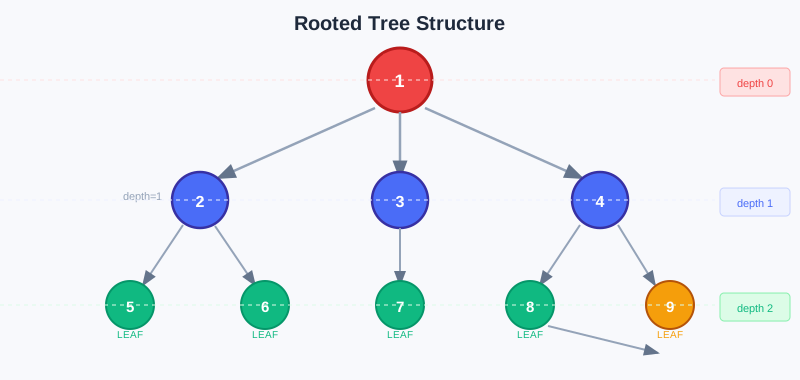
         1          <- root (depth 0)
        / \
       2   3        <- depth 1
      / \   \
     4   5   6      <- depth 2  (4, 5, 6 are leaves)
Tree Vocabulary
| Term | Definition | Example (tree above) |
|---|---|---|
| Root | Designated top node (depth 0) | Node 1 |
| Parent | The unique node directly above | parent(4) = 2 |
| Children | Nodes directly below | children(2) = {4, 5} |
| Leaf | Node with no children | Nodes 4, 5, 6 |
| Depth | Distance from root | depth(6) = 2 |
| Height of node u | Longest path from u down to leaf | height(2) = 1 |
| Height of tree | Max depth of any node | 2 |
| Subtree(u) | Node u plus all its descendants | subtree(2) = {2,4,5} |
| Ancestor of u | Any node on path from u to root | ancestors(6) = {3, 1} |
| LCA(u, v) | Lowest Common Ancestor | LCA(4, 6) = 1 |
Rooting a Tree (Standard DFS Template)
Almost all tree problems require picking a root and computing parent/child relationships. The standard approach: read the tree as an undirected graph, then root with DFS:
int n;
cin >> n;
vector<vector<int>> adj(n + 1);
for (int i = 0; i < n - 1; i++) {
    int u, v;
    cin >> u >> v;
    adj[u].push_back(v);
    adj[v].push_back(u);   // undirected tree edge
}

vector<int> parent(n + 1, 0);
vector<int> depth(n + 1, 0);
vector<vector<int>> children(n + 1);

// Root at node 1 using iterative DFS (safe for N up to 10^5)
// Recursive DFS may stack-overflow for chains (N = 10^5 deep path)
function<void(int, int)> rootTree = [&](int u, int par) {
    parent[u] = par;
    for (int v : adj[u]) {
        if (v != par) {                // v != par avoids going back up
            children[u].push_back(v);
            depth[v] = depth[u] + 1;
            rootTree(v, u);
        }
    }
};
rootTree(1, 0);   // root = 1, sentinel parent = 0
After rootTree(1, 0) completes:
parent[u]= parent of node u (0 if u is the root)children[u]= list of u's children in rooted treedepth[u]= depth of u from root
⚠️ Stack overflow warning for deep trees: Recursive DFS on a path graph of length 10^5 will overflow the default stack (typically 1–8 MB). For safety with large trees, use iterative DFS with an explicit stack, or increase stack size.
Iterative (stack-safe) version:
// Iterative rootTree: BFS-order, safe for any tree shape
vector<int> order;
queue<int> bfsQ;
vector<bool> visited(n + 1, false);
bfsQ.push(1);
visited[1] = true;
parent[1] = 0;
depth[1] = 0;

while (!bfsQ.empty()) {
    int u = bfsQ.front(); bfsQ.pop();
    order.push_back(u);
    for (int v : adj[u]) {
        if (!visited[v]) {
            visited[v] = true;
            parent[v] = u;
            depth[v] = depth[u] + 1;
            children[u].push_back(v);
            bfsQ.push(v);
        }
    }
}
// order[] = BFS traversal order (useful for bottom-up DP)
Preview: What Trees Enable
Trees have special structural properties that enable O(N) algorithms impossible on general graphs:
- Tree DP (Chapter 8.3): DP on subtrees
- LCA / Binary Lifting (Chapter 8.4): O(log N) ancestor queries
- Heavy-Light Decomposition: O(log² N) path queries (Gold/Platinum)
- Centroid Decomposition: O(N log N) distance problems (Platinum)
5.1.5 Weighted Graphs — Storing Edge Costs
So far, our edges have been "bare" — they just say "A connects to B." But many problems assign a cost to each edge (distance, travel time, capacity). Here's how to store that extra information.
// === Method 1: pair<int,int> — compact, common ===
vector<vector<pair<int,int>>> adj(n + 1);
// adj[u] stores {v, w} pairs

// Add undirected weighted edge u–v with weight w:
adj[u].push_back({v, w});
adj[v].push_back({u, w});

// Iterate with C++17 structured bindings:
for (auto& [v, w] : adj[u]) {
    cout << u << " -> " << v << " (cost " << w << ")\n";
}
// === Method 2: struct Edge — clearer for complex graphs ===
struct Edge {
    int to;       // destination vertex
    int weight;   // edge cost
};
vector<vector<Edge>> adj(n + 1);

// Add edge:
adj[u].push_back({v, w});

// Iterate:
for (const Edge& e : adj[u]) {
    relax(u, e.to, e.weight);
}
When to Use long long Weights
If edge weights can reach 10^9 and a path traverses multiple edges, the accumulated sum can overflow 32-bit int (max ~2.1×10^9):
Worst case: N = 10^5 nodes, all edge weights = 10^9
Longest possible path sum ≈ 10^5 × 10^9 = 10^14  → overflows int!
Safe template for Dijkstra / Bellman-Ford:
const long long INF = 2e18;   // safe sentinel for long long distances
vector<vector<pair<int, long long>>> adj(n + 1);
//                         ^^^^^^^^^^^ long long weight
vector<long long> dist(n + 1, INF);
dist[src] = 0;
Rule: If edge weights exceed 10^4 AND path length could exceed a few hundred edges, use
long long. When in doubt, uselong long— the performance difference is negligible.
5.1.6 Common Mistakes to Avoid
These are the bugs that trip up beginners most often. Memorize them — you'll save hours of debugging.
⚠️ Bug #1 — Missing reverse edge in undirected graph (most common!)
// WRONG: only adds one direction
adj[u].push_back(v);    // forgets adj[v].push_back(u) !

// CORRECT: undirected = both directions
adj[u].push_back(v);
adj[v].push_back(u);
Symptom: BFS/DFS visits only half the graph; some vertices appear unreachable.
⚠️ Bug #2 — Off-by-one in adjacency list size
// WRONG: size n, but vertex indices are 1..n → adj[n] out of bounds!
vector<vector<int>> adj(n);

// CORRECT: size n+1 for 1-indexed vertices
vector<vector<int>> adj(n + 1);
Symptom: Undefined behavior, random crashes, or incorrect results for the last vertex.
⚠️ Bug #3 — Local adjacency matrix crashes (stack overflow)
// WRONG: ~1 MB on stack → stack overflow
int main() {
    bool adj[1001][1001];   // local variable on stack!
}

// CORRECT: global array (BSS segment, auto zero-init)
bool adj[1001][1001];   // outside main()
int main() { ... }
⚠️ Bug #4 — Adjacency matrix used for large V (MLE)
// WRONG: V = 100,000 → 10 GB memory!
bool adj[100001][100001];

// CORRECT: use adjacency list for V > 1500
vector<vector<int>> adj(n + 1);
⚠️ Bug #5 — Grid bounds not checked before access
// WRONG: may access grid[-1][c] → undefined behavior!
if (grid[nr][nc] != '#') { ... }

// CORRECT: bounds check FIRST
if (nr >= 0 && nr < R && nc >= 0 && nc < C && grid[nr][nc] != '#') { ... }
⚠️ Bug #6 — Integer overflow in weighted graph distances
// WRONG: edge weight = 10^9, path has 10^5 edges → overflow
int dist[MAXN];

// CORRECT: use long long for distance arrays
long long dist[MAXN];
const long long INF = 2e18;
Chapter Summary
Here's everything from this chapter distilled into quick-reference tables.
Key Takeaways
| Concept | Core Rule | Why It Matters |
|---|---|---|
| Undirected edge | Add both adj[u]←v and adj[v]←u | Forgetting one direction = Bug #1 |
| Directed edge | Add only adj[u]←v | Different from undirected! |
| Adjacency List | vector<vector<int>> adj(n+1) | Default; O(V+E) space |
| Adjacency Matrix | Global bool adj[MAXV][MAXV] | Only V ≤ 1500; O(1) edge check |
| Weighted List | vector<pair<int,int>> or struct | Dijkstra, Bellman-Ford |
| Weighted Matrix | int dist[MAXV][MAXV], INF sentinel | Floyd-Warshall |
| Edge List | vector<{u,v,w}> sorted by weight | Kruskal MST algorithm |
| Grid Graph | dr[]/dc[] direction arrays | No explicit adj list needed |
| Tree | Connected + N−1 edges + no cycles | Enables efficient subtree DP |
| long long weights | When sum can exceed 2×10^9 | Prevent overflow in path sums |
Three Representations at a Glance
Graph: edges 1–2, 1–3, 2–4

Adjacency List:           Adjacency Matrix:         Edge List:
adj[1] = {2, 3}           adj:   1 2 3 4            edges:
adj[2] = {1, 4}             1  [ 0 1 1 0 ]            {1,2}
adj[3] = {1}                2  [ 1 0 0 1 ]            {1,3}
adj[4] = {2}                3  [ 1 0 0 0 ]            {2,4}
                            4  [ 0 1 0 0 ]
Space: O(V+E)             Space: O(V^2)             Space: O(E)
Neighbors: O(deg)         Edge check: O(1)          Sort: O(E log E)
Connections to Later Chapters
| Chapter | What it uses from here |
|---|---|
| 5.2 BFS & DFS | Adjacency list built here; this chapter is a hard prerequisite |
| 5.3 Trees & DSU | Tree representation + adds Union-Find data structure |
| 5.4 Shortest Paths | Dijkstra uses weighted adj list; Floyd uses weighted matrix |
| 6.x Dynamic Programming | Grid graph enables grid DP; DAG enables DP on DAG |
| 8.1 MST | Kruskal uses edge list; Prim uses adj list — both representations |
| 8.3 Tree DP | Rooted tree structure from §5.1.4; children[] array pattern |
| 8.4 Euler Tour / LCA | Binary lifting built on depth[] and parent[] from §5.1.4 |
FAQ
Q: Should I use 0-indexed or 1-indexed vertices?
USACO input is almost always 1-indexed (vertices labeled 1 to N). Use
vector<vector<int>> adj(n + 1)and leave slot 0 unused. This matches input directly and avoids off-by-one errors.
Q: Does a grid graph need an explicit adjacency list?
No. Grid neighbors are computed on-the-fly with
dr[]/dc[]arrays — more memory-efficient and typically cleaner code.
Q: When should I use long long for edge weights?
When weights can reach 10^9 AND you might sum multiple edges (shortest path, total cost). The product 10^9 × path_length can easily exceed 2^31 − 1 ≈ 2.1×10^9. When in doubt, use
long long.
Practice Problems
These problems test the concepts from this chapter. Start with the Easy ones to build confidence, then try the Medium ones to solidify your understanding.
Problem 5.1.1 — Degree Count 🟢 Easy
Problem: Read an undirected graph with N vertices and M edges. Print the degree of each vertex (number of edges incident to it).
Input:
N M
u₁ v₁
u₂ v₂
...
Sample Input 1:
4 4
1 2
2 3
3 4
4 1
Sample Output 1:
2 2 2 2
Sample Input 2:
5 3
1 2
1 3
1 4
Sample Output 2:
3 1 1 1 0
Constraints: 1 ≤ N ≤ 10^5, 0 ≤ M ≤ 2×10^5, 1 ≤ u, v ≤ N
💡 Hint
Keep a degree[] array. For each edge (u, v), do degree[u]++ and degree[v]++.
The Handshaking Lemma says the sum of all degrees equals 2M — you can verify your answer.
✅ Full Solution
#include <bits/stdc++.h>
using namespace std;

int main() {
    ios_base::sync_with_stdio(false);
    cin.tie(NULL);

    int n, m;
    cin >> n >> m;

    vector<int> degree(n + 1, 0);

    for (int i = 0; i < m; i++) {
        int u, v;
        cin >> u >> v;
        degree[u]++;
        degree[v]++;   // undirected: both endpoints gain +1 degree
    }

    for (int u = 1; u <= n; u++) {
        cout << degree[u];
        if (u < n) cout << " ";
    }
    cout << "\n";

    return 0;
}
// Time: O(N + M),  Space: O(N)
// Verification: sum(degree) should equal 2*M (Handshaking Lemma)
Problem 5.1.2 — Is It a Tree? 🟢 Easy
Problem: Given a connected undirected graph with N vertices and M edges, determine if it is a tree.
Input: Standard edge list format.
📋 Sample Input/Output 1 (306 lines, click to expand)
Sample Input 1:
5 4
1 2
1 3
3 4
3 5
Sample Output 1: YES
Sample Input 2:
4 4
1 2
2 3
3 4
4 1
Sample Output 2: NO (4 nodes, 4 edges — has a cycle. Tree needs exactly N−1 = 3 edges.)
Constraints: 1 ≤ N ≤ 10^5, 1 ≤ M ≤ 2×10^5
💡 Hint
For a connected graph: it is a tree if and only if M = N − 1. No cycle-detection algorithm is needed — the edge count alone suffices for connected graphs.
✅ Full Solution
#include <bits/stdc++.h>
using namespace std;

int main() {
    ios_base::sync_with_stdio(false);
    cin.tie(NULL);

    int n, m;
    cin >> n >> m;

    for (int i = 0; i < m; i++) {
        int u, v;
        cin >> u >> v;   // read edges (not used in this simple check)
    }

    cout << (m == n - 1 ? "YES" : "NO") << "\n";
    return 0;
}
// Time: O(M),  Space: O(1)
⚠️ Caveat: This only works when the graph is guaranteed connected. For a possibly disconnected graph, you must also verify connectivity using BFS/DFS (Chapter 5.2). A disconnected graph with N−1 edges is a forest (multiple trees), not a single tree.
Problem 5.1.3 — Reachability in Directed Graph 🟡 Medium
Problem: Given a directed graph with N vertices, M edges, and two vertices S and T: is T reachable from S by following directed edges?
Input:
N M S T
u₁ v₁
...
Sample Input 1:
5 4 1 4
1 2
2 3
3 4
1 5
Sample Output 1: YES (Path: 1 → 2 → 3 → 4)
Sample Input 2:
4 3 4 1
1 2
2 3
3 4
Sample Output 2: NO (Edges only go forward 1→2→3→4, not backward)
Constraints: 1 ≤ N ≤ 10^5, 0 ≤ M ≤ 2×10^5
💡 Hint
Build a directed adjacency list (only add adj[u].push_back(v), not the reverse). Run BFS from S. If T is visited, output YES.
✅ Full Solution
#include <bits/stdc++.h>
using namespace std;

int main() {
    ios_base::sync_with_stdio(false);
    cin.tie(NULL);

    int n, m, S, T;
    cin >> n >> m >> S >> T;

    vector<vector<int>> adj(n + 1);
    for (int i = 0; i < m; i++) {
        int u, v;
        cin >> u >> v;
        adj[u].push_back(v);   // directed: one direction only
    }

    vector<bool> visited(n + 1, false);
    queue<int> q;
    visited[S] = true;
    q.push(S);

    while (!q.empty()) {
        int u = q.front(); q.pop();
        for (int v : adj[u]) {
            if (!visited[v]) {
                visited[v] = true;
                q.push(v);
            }
        }
    }

    cout << (visited[T] ? "YES" : "NO") << "\n";
    return 0;
}
// Time: O(V + E),  Space: O(V + E)
Problem 5.1.4 — Leaf Count 🟢 Easy
Problem: A rooted tree with N nodes has root = node 1, given as a parent array. Count the leaf nodes (nodes with no children).
Input:
N
p₂ p₃ ... pₙ
(N−1 parent values for nodes 2 through N)
Sample Input 1:
5
1 1 2 2
Sample Output 1: 3 (Tree: 1→{2,3}, 2→{4,5}. Leaves: 3, 4, 5)
Sample Input 2:
1
Sample Output 2: 1 (Single node is both root and leaf)
Constraints: 1 ≤ N ≤ 10^5
💡 Hint
A node is a leaf iff it never appears as a parent. Track hasChild[u]. Any node with hasChild[u] = false is a leaf.
✅ Full Solution
#include <bits/stdc++.h>
using namespace std;

int main() {
    ios_base::sync_with_stdio(false);
    cin.tie(NULL);

    int n;
    cin >> n;

    vector<bool> hasChild(n + 1, false);

    for (int i = 2; i <= n; i++) {
        int parent;
        cin >> parent;
        hasChild[parent] = true;   // parent has at least one child
    }

    int leaves = 0;
    for (int u = 1; u <= n; u++) {
        if (!hasChild[u]) leaves++;
    }

    cout << leaves << "\n";
    return 0;
}
// Time: O(N),  Space: O(N)
Trace for Sample 1:
Input:  N=5,  parents: p[2]=1, p[3]=1, p[4]=2, p[5]=2
hasChild: [ _, true, true, false, false, false ]   (index 0 unused)
Leaves (hasChild=false): nodes 3, 4, 5  →  count = 3  ✓
Problem 5.1.5 — Grid Edge Count 🟡 Medium
Problem: Read an N×M grid where . = passable and # = wall. Count the number of edges in the implicit undirected graph (two adjacent passable cells share one edge).
Input: Grid format.
Sample Input 1:
3 3
...
.#.
...
Sample Output 1: 8
Sample Input 2:
2 2
..
..
Sample Output 2: 4
Constraints: 1 ≤ N, M ≤ 1000
💡 Hint
For each passable cell, check only its right and bottom neighbors to avoid double-counting. If both cells are passable, count one edge.
✅ Full Solution
#include <bits/stdc++.h>
using namespace std;

int main() {
    ios_base::sync_with_stdio(false);
    cin.tie(NULL);

    int n, m;
    cin >> n >> m;

    vector<string> grid(n);
    for (int r = 0; r < n; r++) cin >> grid[r];

    int edges = 0;
    for (int r = 0; r < n; r++) {
        for (int c = 0; c < m; c++) {
            if (grid[r][c] == '#') continue;
            // Check right neighbor
            if (c + 1 < m && grid[r][c+1] == '.') edges++;
            // Check bottom neighbor
            if (r + 1 < n && grid[r+1][c] == '.') edges++;
        }
    }

    cout << edges << "\n";
    return 0;
}
// Time: O(N*M),  Space: O(N*M)
Trace for Sample 1 (3×3 grid with center wall):
. . .       Right edges: (0,0)-(0,1), (0,1)-(0,2), (2,0)-(2,1), (2,1)-(2,2) = 4
. # .       Down  edges: (0,0)-(1,0), (0,2)-(1,2), (1,0)-(2,0), (1,2)-(2,2) = 4
. . .       Total = 8  ✓
Problem 5.1.6 — Adjacency Matrix Build + Query 🟢 Easy
Problem: Given an undirected unweighted graph with N vertices (N ≤ 500) and M edges, build an adjacency matrix and answer Q queries: for each query (u, v), print 1 if edge u–v exists, 0 otherwise.
Input:
N M
u₁ v₁
...
Q
a₁ b₁
...
Sample Input:
4 4
1 2
1 3
2 4
3 4

3
1 2
2 3
1 4
Sample Output:
1
0
0
Constraints: 1 ≤ N ≤ 500, 0 ≤ M ≤ N*(N-1)/2, 1 ≤ Q ≤ 10^5
💡 Hint
Build the adjacency matrix in O(M). Each query is O(1). This demonstrates why adjacency matrix beats adjacency list (O(deg) per query) when Q is large and N is small.
✅ Full Solution
#include <bits/stdc++.h>
using namespace std;

const int MAXV = 501;
bool adj[MAXV][MAXV];   // global: auto zero-initialized, no stack overflow

int main() {
    ios_base::sync_with_stdio(false);
    cin.tie(NULL);

    int n, m;
    cin >> n >> m;

    for (int i = 0; i < m; i++) {
        int u, v;
        cin >> u >> v;
        adj[u][v] = true;
        adj[v][u] = true;   // undirected
    }

    int q;
    cin >> q;
    while (q--) {
        int a, b;
        cin >> a >> b;
        cout << (adj[a][b] ? 1 : 0) << "\n";   // O(1) per query!
    }

    return 0;
}
// Build: O(M),  Query: O(1) each,  Total: O(M + Q)
// Space: O(V^2) = O(500^2) = 250,000 bytes ≈ 250 KB  ✅
//
// With adjacency list: each query would be O(deg(a)) = up to O(N) per query
// = O(Q * N) = 10^5 * 500 = 5*10^7 — TLE risk. Matrix wins here!